A text unit, not a document page
A cartella measures text independently of font, size and margins. Thirty lines × sixty characters explains 1,800; it does not require forcing every line to that length. Long words wrap early and short headings occupy space. Required layout and a cartelle limit are separate requirements: meeting the formatting requirement does not prove length compliance.
Choose the agreed divisor
AITI specifies 2,000 characters including spaces for editorial translation; La Sinossi specifies 1,800 in its submission instructions. These are different stated conventions. For “ten cartelle”, confirm the size rather than inferring it from editorial, commercial, legal or academic labels. Calculator presets are options, not mandatory professional standards. Record the selected divisor beside the result; “12 cartelle” alone is not reproducible.
Define the included material
Check the contract or submission rules for title, subheadings, notes, bibliography, tables and captions. Count a chapter, its twenty notes and bibliography separately so different totals remain reproducible without altering the original. Our DOCX reader excludes items such as headers and notes; PDF columns may extract in a different order. Count missing required material separately. Extraction limitations do not authorize editorial exclusions.
A reproducible calculation
27,900 characters including spaces ÷ 1,800 = 15.5 cartelle; ÷ 2,000 = 13.95. Reverse checks give 15.5 × 1,800 = 27,900 and 13.95 × 2,000 = 27,900. A mismatch suggests copying, premature rounding or mixed versions. Fifteen cartelle of 1,800 allow 27,000 characters: this text exceeds the limit by 900, regardless of a rounded display. Rounding cannot authorize an overrun.
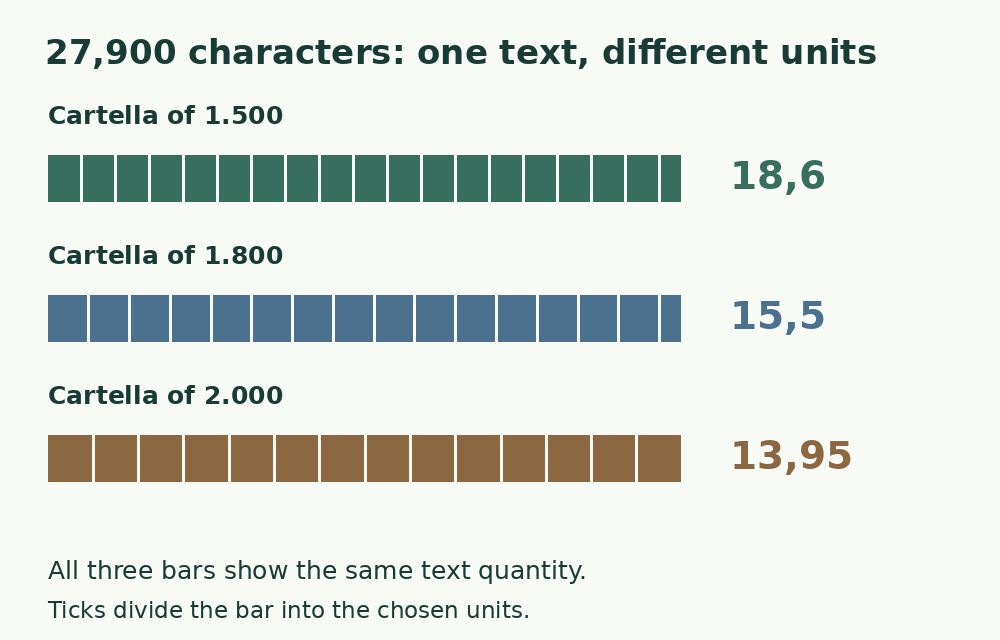
Actual and billed quantities
Fractions remain part of the text. An agreement may bill proportionally or round up: 15.5 × an illustrative €8 = €124; sixteen whole units cost €128. This is arithmetic, not a market rate; minimum charges, extra services and tax components are separate. Specify whether rounding applies per chapter or once to the whole project. Preserve actual and billed quantities separately.
Words and pages require assumptions
Word length, spaces, punctuation and numbers prevent a fixed word conversion. Twenty units of 1,800 = 36,000 characters: assuming six characters per word gives about 6,000 words; seven gives about 5,143. Both are conditional planning estimates, not counts of finished text. Pages additionally require a layout model. Use the requested measure for final compliance.
For details, see cartelle and page estimates.
Record and recheck
Save filename, version, characters, divisor, exclusions and extraction method. For example: “27,900 characters including spaces, body and notes, 15.5 cartelle of 1,800”. Recount the actual delivery after revision rather than subtracting an estimated cut: substitutions affect punctuation and spaces too. Use the recipient’s prescribed software for the final check and ask about unclear scope. An independent counter cannot decide another party’s agreement.
Several files
Count each chapter once and retain subtotals. Do not add a standalone chapter again when it also appears in the complete manuscript. Check repeated book titles and front matter: appearing in every file does not automatically require repeated inclusion. Choose one reference copy for the overall count and use subtotals to verify it.
The same text, three unit sizes
| Text characters | Cartella size | Actual cartelle |
|---|---|---|
| 27.900 | 1.500 | 18,6 |
| 27.900 | 1.800 | 15,5 |
| 27.900 | 2.000 | 13,95 |
Sources and checks
- AITI, condizioni per la traduzione editoriale · The recipient-specific 2,000-character or 1,800-character convention, spaces included.
- La Sinossi, istruzioni di invio · The recipient-specific 2,000-character or 1,800-character convention, spaces included.