Why a number is insufficient
“40,000 characters” leaves open which file and whether notes count. A reproducible sheet preserves these choices instead of relying on memory. Use a short document, table or project note sized to real ambiguity, not compulsory paperwork. OPUS illustrates text, abstracts and separate materials, where counted content differs from content merely attached.
Identify the material
Record project title, exact filename, date/version and counted section. Separate chapters need a component list. A local computer path alone is not portable to a recipient; filename/version and optional internal code work better when titles change. Omit unnecessary personal data and full text. Confidential documents remain in the designated working system; record only sufficient identifying details.
Record scope
Mark body, headings, notes, bibliography, tables, captions and attachments included, excluded or separately measured. “Body only, title excluded” may suffice for simple work; use rows for complex material. “Not extracted” does not mean “excluded”: required unread text is pending work, not a final omission. Keep a reference to recipient clarification without attaching all correspondence or assuming it applies to another project.
Record method
Identify words or characters, spaces, cartella size and page-estimate sample/settings. State tool and separate steps, such as pasted body plus separately counted notes. Record prescribed software only when that final check was actually performed; do not attribute unperformed verification to this site. The counting method describes our engine. A brief method note resolves differences better than a universal accuracy claim.
Exact quantities and limits
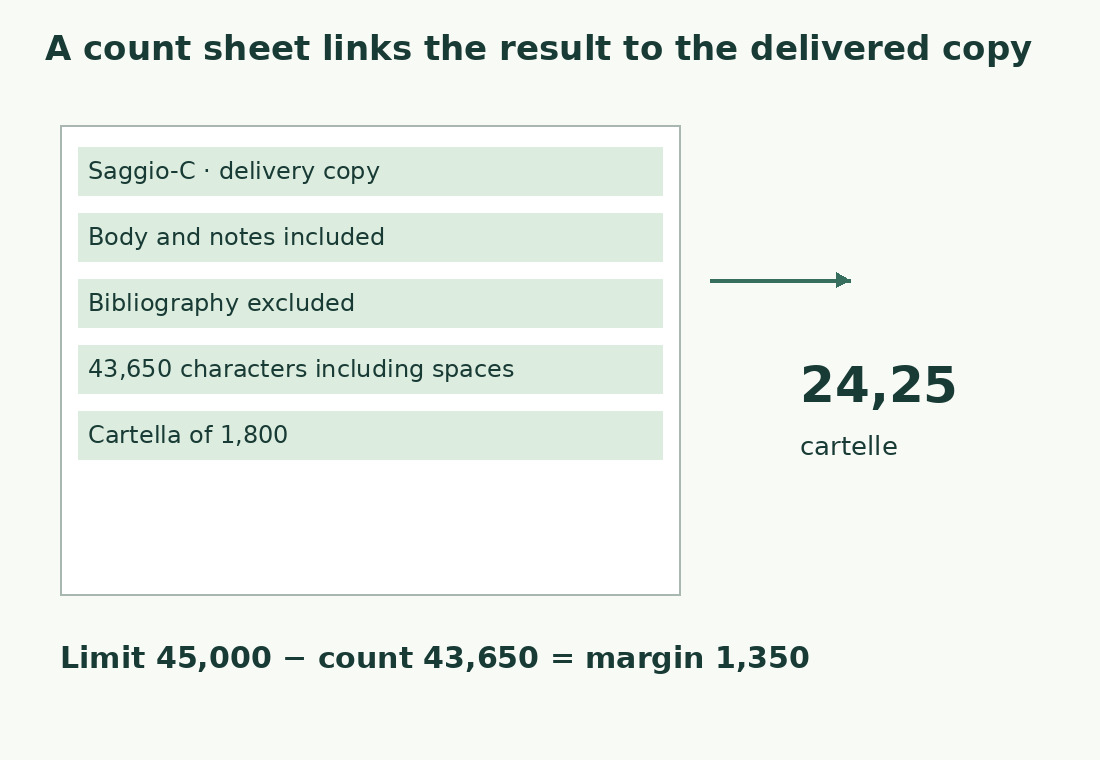
43,650 included characters ÷ 1,800 = 24.25 cartelle. Keep exact characters and conversion rather than only “about twenty-four”. Billing rounded up to twenty-five does not change text length; preserve actual and billed amounts separately. Against 45,000, 1,350 characters remain. Rounded cartelle cannot replace a precise character-limit check.
Keep history
New versions need new rows/sheets; preserve records of completed deliveries. Record additions and removals where relevant: removing 2,000 and adding 2,000 leaves net quantity unchanged but replaces content. In shared projects, assign one owner or defined update step instead of maintaining conflicting summary copies. The reference must stay aligned with the delivered document.
Verify actual files
Open delivery-folder files and inspect names, beginning, ending and major components. Compare chapter/figure inventories with the assembled copy. Check a small portion through another route to detect selection mistakes, not to pick a favorable result. Explain resolved differences rather than archiving competing unexplained totals. Calculator exports supply results/settings but cannot know editorial scope or material never entered in the editor.
Use appropriate detail
The recipient may need only a requested declaration while the full sheet stays internal. Complex submissions benefit from attachment lists and subtotals. Scale detail to a story, collection, note-heavy essay or bilingual work. A sheet is complete when someone with the same files and instructions can reproduce the count. It documents a measurement and its decisions, not quality or eligibility.
A completed minimum count sheet
| Field | Example | Purpose |
|---|---|---|
| File/version | Saggio-C, delivery copy | Identifies the material |
| Scope | Body and notes; bibliography excluded | Identifies content |
| Characters including spaces | 43,650 | Keeps the exact quantity |
| Cartella | 1,800 characters | Defines the divisor |
| Actual cartelle | 24.25 | Shows conversion |
| Delivery limit | 45,000; margin 1,350 | Separates requirement from result |
Sources and checks
- Università di Chieti-Pescara, norme OPUS · Separate text, abstract and supporting-material requirements.