Read the recipient’s rule
Theses, essays, competitions and journals have no single shared rule. OADI includes notes within its allowed length; another recipient may differ. Look for “notes included”, “bibliography excluded” or “everything included”. For an undefined word limit, ask about title, abstract, notes, quotations and references rather than borrowing the previous project’s rule.
Check program exclusions
Google Docs states that without a selection its count excludes headers, footers and footnotes. That default does not override editorial requirements. When notes must count, use a suitable option, separate measurement or prescribed tool, not a guessed allowance per note. Our DOCX reader also omits some apparatus. Read import notice and counting method: a lower count can mean unread material rather than different word rules.
Inventory components
Separate title/subheadings, abstract, body, notes, bibliography, appendices and captions. Use one relevant measure: do not add body words to note characters. For cartelle, obtain a homogeneous character total before division. Preserve the original and label temporary counting copies so they are not delivered accidentally. Recount updated components instead of combining subtotals from different drafts.
Three scopes
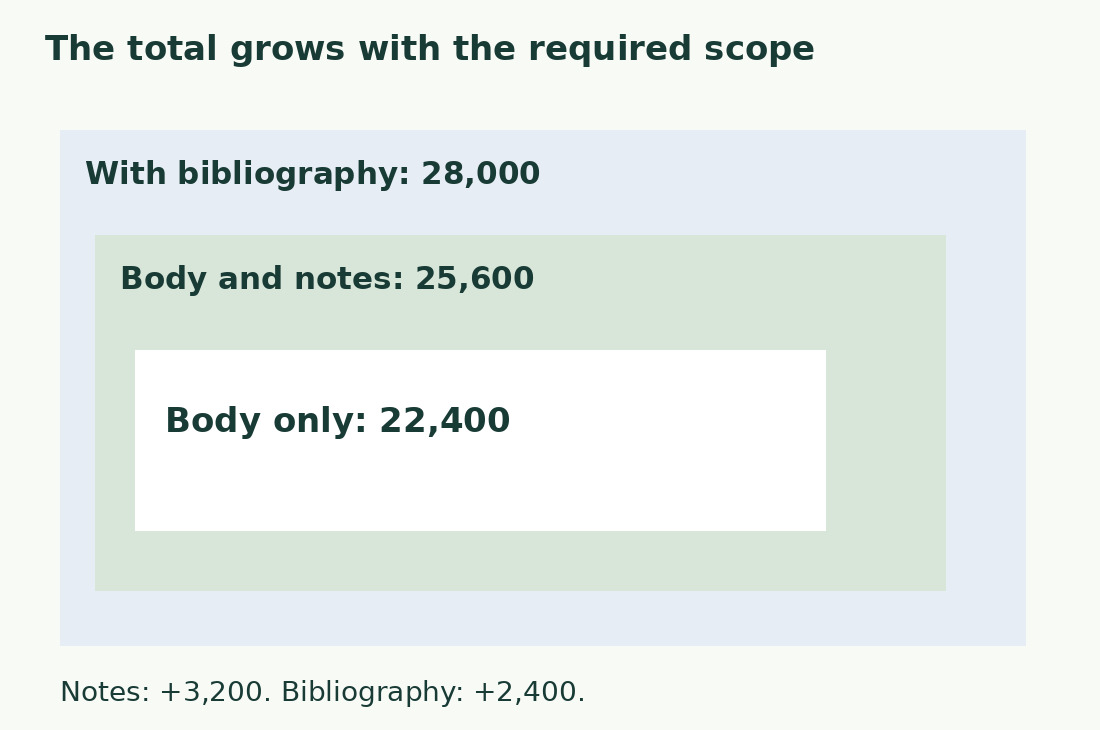
Hypothetically, body 22,400 + notes 3,200 + bibliography 2,400 = 28,000 characters. Excluding bibliography gives 25,600; excluding notes too gives 22,400. These answer different scope questions. Label “25,600 characters, body and notes”. At 1,800 per cartella, this is about 14.2222. Do not round downward to look compliant; compare the actual quantity required by the rules.
Quotations and references
A quotation inside a paragraph belongs to measured text unless a rule excludes it. Its origin does not remove its length; citation rights are separate. An author/year parenthesis in the body differs from a full bibliography entry. Excluding bibliography does not automatically exclude internal references. Do not move bibliography into notes simply to manipulate the relevant total: follow the required editorial structure.
Appendices
Attachments can be administrative support or substantive questionnaires, catalogues and interviews. A separate file does not itself establish exclusion. Check publication versus support-material instructions; if unclear, supply subtotals and ask which aggregate applies. Record excluded appendices and keep them identifiable. They may still require quoted work while outside an essay’s publication limit.
Verify extraction and sums
Check beginning, middle and ending of notes and references, not just their first entry. Retain subtotals and compare their sum with a whole-document count under the same criteria. Differences can reveal an added title, repeated header or duplicated block. The character counter measures pasted plain text, not original note integrity. Interpret changed note markers and layout using declared software rules.
Report and recount
State full unit and relevant breakdown: “body and notes 25,600 characters including spaces; bibliography excluded, 2,400”. Record treatment of titles/abstract if useful. Preserve editorial clarifications and checked rules’ date/version. After the final edit, recount the delivered file: references, notes and title changes alter quantity even when agreed scope remains unchanged.
One document, three scopes
| Scope | Calculation | Characters |
|---|---|---|
| Body | 22,400 | 22,400 |
| Body and notes | 22,400 + 3,200 | 25,600 |
| Body, notes and bibliography | 22,400 + 3,200 + 2,400 | 28,000 |
Sources and checks
- OADI, norme redazionali · Recipient-specific inclusion of notes or Google Docs default exclusions.
- Google, conteggio parole · Recipient-specific inclusion of notes or Google Docs default exclusions.