Different meanings of page
A page may mean a word-processor page, printed A4 sheet, finished book page or conventional text quantity. Double spacing can add pages without adding a sentence; a heading on a new page takes space but few characters. Print runs and covers need a layout project; a cartelle limit needs characters. Identify the actual task before converting.
A page defined in characters
Edizioni Cinque Terre defines its requested pages by character quantity. Follow that convention rather than your computer’s sheet count. Hypothetically, thirty pages of 2,000 = 60,000 characters = 33.333… cartelle of 1,800. Different unit sizes explain the result. Do not infer 60,000 from another publisher’s unspecified “thirty pages”: check or ask. One recipient’s convention is not universal.
Layout-independent calculation
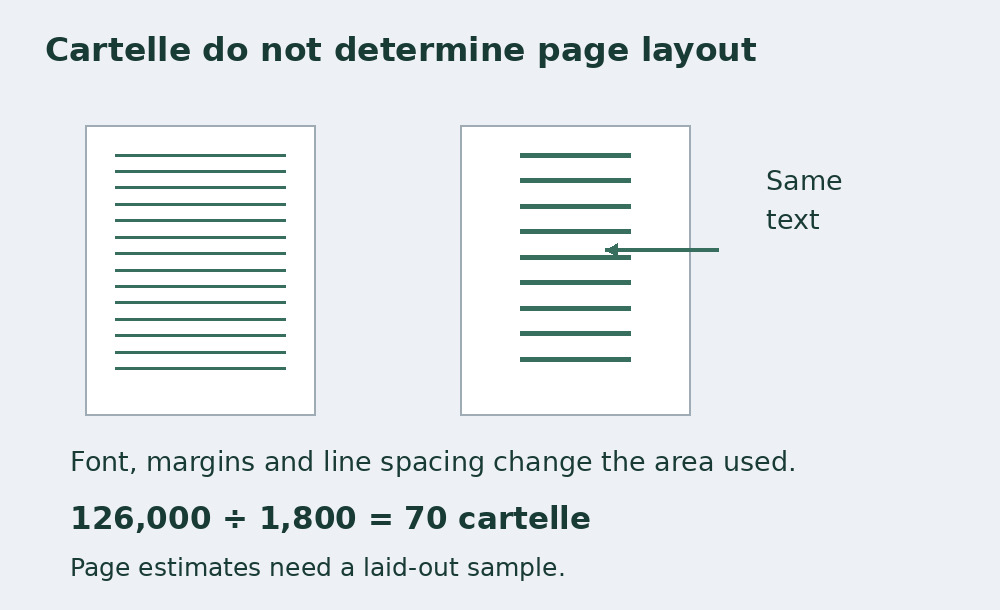
126,000 characters including spaces = seventy cartelle of 1,800 or sixty-three of 2,000. Font and page-break changes leave these results unchanged if text stays the same. Update after cuts or additions, not formatting alone. Establish whether title page, contents and appendices belong in the counted manuscript. The cartella calculator makes division transparent after scope is decided.
Build a page estimate
Use representative pages laid out like the intended result, not only very full pages or sparse openings. Ten sample pages with 21,000 characters average 2,100 per page. At those settings, 126,000 suggests about sixty pages if remaining content is similar, not a guarantee. Keep the sample and record page format, font, size, spacing and margins; report “about sixty pages using the attached settings”.
Sources of variation
Dialogue, lists, poems and quotations leave differing white space. New-page chapter openings create gaps; long table cells expand rows and shift content. Heavy footnotes reduce the body area, making a note-free sample misleading. For mixed material, estimate continuous text, apparatus, plates and openings separately using relevant samples, then add. This exposes uncertainty and allows revision when better information arrives.
Avoid false fixed conversions
There is no universal words-per-page value, direct cartelle-to-A4 ratio or transfer from source-document pages to printed book pages. All require layout specifications. Shrinking the font cannot satisfy a character limit; meeting cartelle alone cannot satisfy required formatting. Give designers and publishers stable text quantity and conditional pagination with their own units.
Report assumptions
Record characters, cartella size and any page estimate with provisional layout and sample. For “How many pages are ten cartelle?”, first give exactly 18,000 characters for units of 1,800, then explain the missing destination template. This identifies what can be calculated immediately and what remains conditional, without making an unjustified promise.
When estimation ends
Read actual pages from the final layout. Check treatment of cover, title page, blank pages and apparatus: print total and body-only total can differ. Keep the checked PDF version. Exporting the same source again with changed fonts or settings may change pagination.
126,000 characters, four different results
| Reference | Operation | Result |
|---|---|---|
| Cartella of 1,800 | 126,000 ÷ 1,800 | 70 exact cartelle |
| Cartella of 2,000 | 126,000 ÷ 2,000 | 63 exact cartelle |
| Sample at 2,100 characters/page | 126,000 ÷ 2,100 | About 60 pages |
| Book without a layout specification | Insufficient information | Pages cannot be determined |
Sources and checks
- Edizioni Cinque Terre, invio manoscritti · A recipient-specific page definition in characters.