Identify the selection
First pages, first chapters, a cartelle quantity and a representative sample authorize different selections. Do not replace a requested opening with your favorite chapter. La Sinossi illustrates first-thirty-cartelle instructions; others may request the whole work. This example explains measurement, not whether submissions are open or suitable for your project. Record start, quantity, unit, format and title/author rules; correct length can still cover the wrong portion.
Calculate the threshold
Thirty units of 1,800 = 54,000 characters; thirty of 2,000 = 60,000. The 6,000 difference changes the excerpt. For thirty document pages, inspect page settings instead: 54,000 is unjustified without a character definition. Use the character counter or prescribed tool, not estimated words. Dialogue and dense descriptions have differing word/character/page ratios.
For details, see cartelle and page estimates.
Choose a permitted ending
The threshold can fall inside a word, sentence or chapter. “Maximum 54,000” does not authorize finishing a chapter at 60,000; “about thirty cartelle” may need a margin clarification. Where allowed, stop slightly earlier at a readable ending and record actual length. Ask when an exact portion is prescribed. Create a separate excerpt copy; never cut the only complete original.
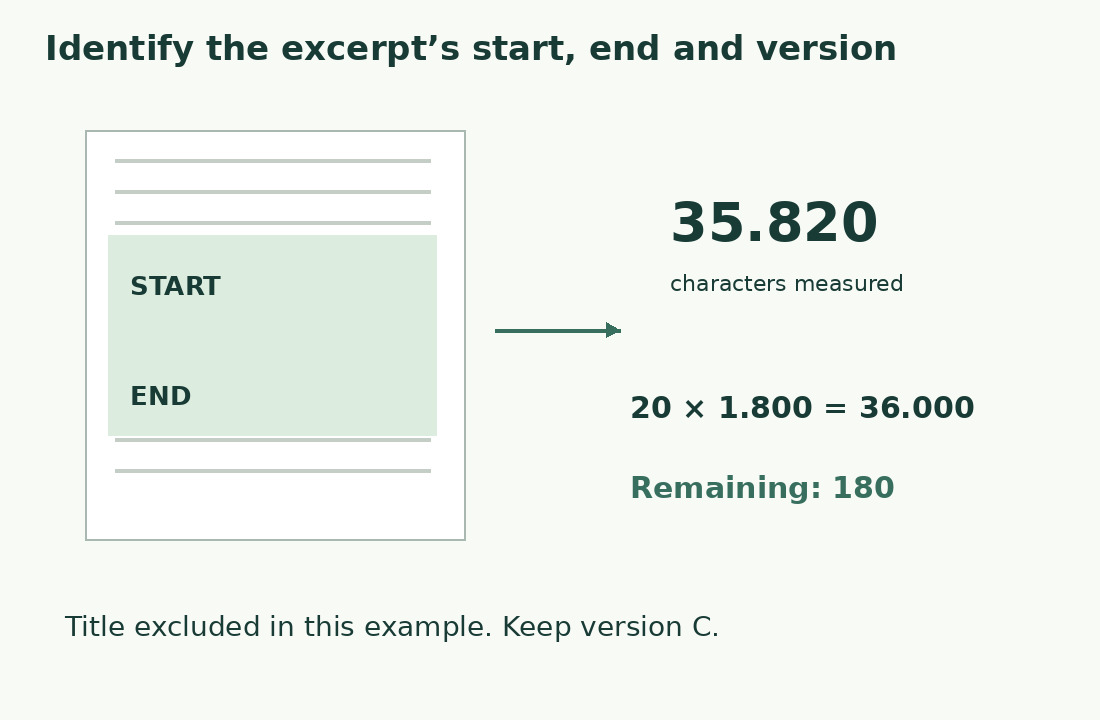
Initial material
Title page, dedication, epigraph, contents and other preliminaries can precede narrative. Including many service pages may displace the sample requested as first narrative pages. List these components and clarify the starting point instead of silently deleting them. Check anonymity separately. Keep title and introduction subtotals where they might enter the limit, so selection scope is reproducible.
Check copying
Inspect beginning, middle and ending after transfer: a count cannot prove continuity or detect a skipped paragraph or extra chapter. Ensure notes, tables and special breaks remain intelligible; a cut note or missing table heading can impair reading. Follow apparatus rules instead of adding material freely above the maximum. Name the copy explicitly as an excerpt, visibly distinct from the complete manuscript even when attachments are reordered.
Separate synopsis
The excerpt reproduces the work; the synopsis describes it. Count separately where separately requested, as each can have its own ceiling. Align them with the same manuscript version, including opening, names and chapter order. An internal record such as “manuscript C; excerpt C; short synopsis C” prevents mismatched documents without adding unnecessary technical apparatus to the proposal.
Worked example
For “first twenty cartelle of 1,800, maximum, title excluded”, the narrative ceiling is 36,000. An excerpt of 35,820 ending at a sentence has 180 remaining; this does not authorize another 500-character passage. Keep the excluded title separate and add it if different instructions include it. Twenty units of 2,000 would be 40,000; 36,000 would then be eighteen, not twenty. Report actual length, not the target.
Archive the excerpt
Record manuscript version, start/end, characters, unit and exclusions. Short opening/closing quotations can identify nonconfidential material in an internal record. Preserve the delivered copy and use a new version for later edits, rather than overwriting an already submitted excerpt. Reproducible quantity checks accompany careful instruction reading and inspection of the actual saved attachment.
From instructions to a reproducible selection
| Step | Hypothetical example | Check |
|---|---|---|
| Unit | 20 × 1,800 | Maximum 36,000 characters |
| Scope | Title excluded | Narrative text only |
| Selected portion | 35,820 characters | 180 below maximum |
| Saved copy | Excerpt from version C | Same start and end as the reference |
Sources and checks
- La Sinossi, linee guida per il manoscritto · First-thirty-cartelle instructions with a defined unit.