What does the offer include?
€14 per cartella cannot be compared with €16 if one unit has 1,500 characters and the other 2,000. AITI model contracts specify unit and payment. Make a quantity/unit/rate/amount sheet; this checks arithmetic and clarity, not legal interpretation. Ordinary text, rebuilt tables, image transcription and new layout involve different work. Character quantity alone cannot determine effort or a fair price.
Source or target text
A source-based count is available initially; a final target-based count generally follows translation unless a fixed amount or other condition is agreed. Language pair, content, style and editing prevent universal expansion percentages. Hypothetically, 30,000 source and 33,000 target characters ÷ 1,500 = twenty and twenty-two cartelle. At an illustrative €12: €240 or €264. These numbers explain count basis, not a prediction for your translation.
For details, see source and translated text counts.
Complete arithmetic
31,500 characters including spaces ÷ 1,500 = twenty-one cartelle; × an illustrative €12 = €252. Reversing gives twenty-one × 1,500 = 31,500. Enter the agreed rate in the calculator, not the example as a market recommendation. Taxes, contributions, minima and extra services are not added automatically. Keep division precision and round at the agreed stage: multiplying a two-decimal display can accumulate errors across small files.
Rounding location matters
Two files of 2,100 each are 1.4 cartelle of 1,500 each. The batch has 4,200 characters = 2.8, rounded up once to three. Rounding each file up to two bills four instead. State the rule, especially for many short files, and retain actual 2.8 beside billed quantity. This separates counting discrepancies from commercial conditions.
Equivalent rates
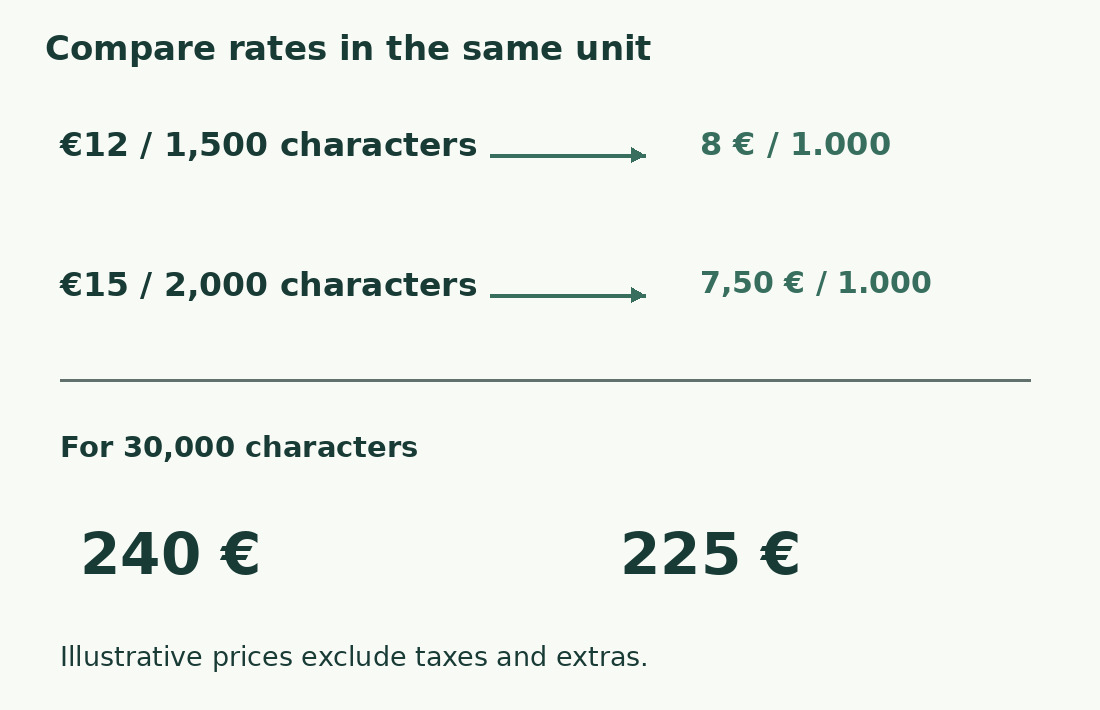
For equivalent services, €12 per 1,500 = €8 per 1,000; €15 per 2,000 = €7.50 per 1,000. The higher nominal price is lower per character here. New rate = old rate × new size ÷ old size: €12 × 1,800 ÷ 1,500 = €14.40. This preserves price per character, not quality rankings or identical services. Revision, terminology checks, formats and deadlines may differ.
Outside the simple product
Minimum charges, urgency and design can be separate. Scans may require transcription or recognition. Check attachments and image text before approving a quantity; a body-only count can miss work. Explain omissions and ask how they are treated. Confirm applicable tax components with the issuer rather than applying generic tables. The calculator estimates entered service amounts, not tax compliance.
Reproducible quote
Record project, basis, characters, divisor, rate and fraction rule with file list, services, deadline and complete economic conditions. Preserve counted versions. After changes, measure the new copy without erasing the old count, record differences and clarify included revision versus new material. To resolve discrepancies, first align basis, units, attachments and per-file rounding on identical files.
Numeric entry
Twenty cartelle at €12 should not produce thousands. Check separators and whether a character count received a cartella rate. Convert a per-1,000-character price before entering a per-cartella field. Label the original unit and test one cartella before calculating the whole project.
Compare the same text quantity
| Hypothetical offer | Cost per 1,000 characters | Cost per 30,000 characters |
|---|---|---|
| €12 / 1,500 characters | €8.00 | €240.00 |
| €15 / 2,000 characters | €7.50 | €225.00 |
| €12 / 1,500 converted to 1,800 | €14.40 / 1,800 | €240.00 |
Sources and checks
- AITI, contratti tipo · Explicit unit, source/target basis and payment in model contracts.