Choose the basis
“Twenty cartelle of translation” is incomplete without identifying the text. The original exists initially; translation changes during work. Giuritrad describes its own source/target approach, illustrating a condition to disclose rather than a rule binding every agency. Label quantities “characters of the Italian original” or “characters of the delivered French version”, with filename or date to distinguish drafts.
Two files, two quantities
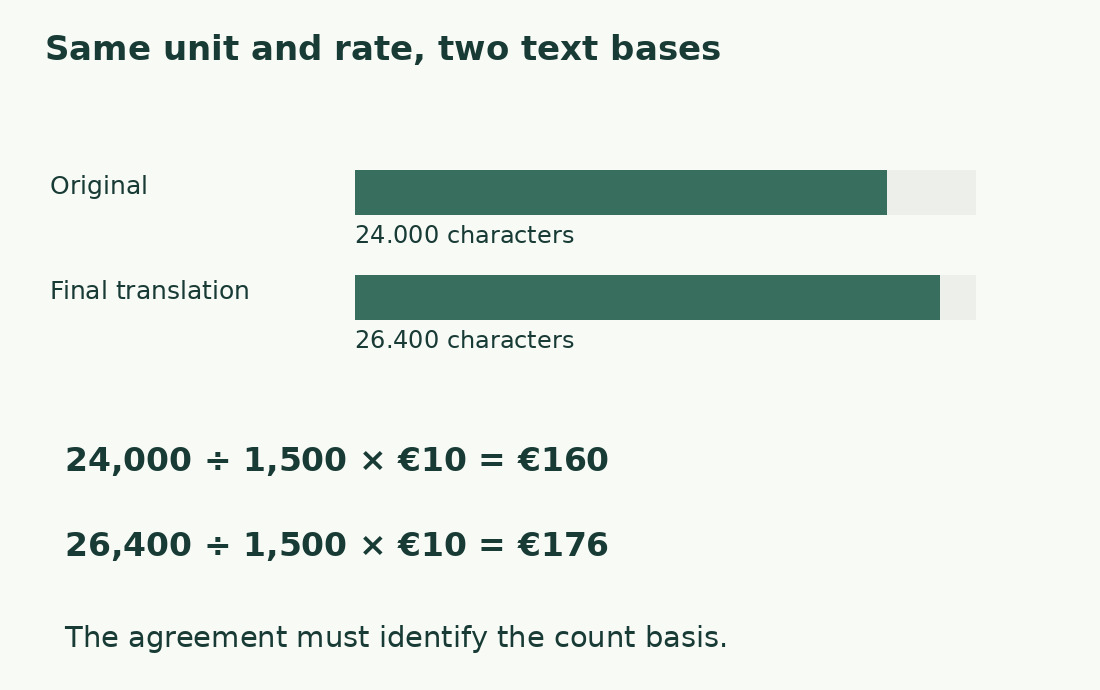
An invented original of 24,000 and final translation of 26,400 characters contain sixteen and 17.6 cartelle of 1,500. At an illustrative €10, totals are €160 and €176. The 2,400-character difference is 10% of the original. Neither that expansion nor the rate predicts other work. Use the calculator on each version, preserve both results and identify the payment basis; do not erase an earlier budget assumption.
No fixed language-pair ratio
Text type, terminology, syntax and information made explicit affect length. Technical lists with codes need not behave like dialogue in the same language direction. Agreed localization rewrites can change information itself. Document a forecast as an estimate, using a representative sample or agreed total price rather than a universal percentage. Actual quantity comes from the real file when available.
Compare equivalent scope
Product names may remain unchanged, quotations stay in the original language and captions arrive separately. Inventory body, headings, tables, notes, captions and attachments; mark translation, checking only or exclusion. Short complex blocks may require different work. Check image extraction: comparing a full translated transcription with an original whose figures were unread falsely attributes missing material to language expansion.
Repetitions and duplicates
A sentence occurring ten times appears ten times in the raw count; any repetition discount is a separate agreement. A chapter attached alone and inside the complete volume is not twice the new material. Repeated clauses in separate deliverables require clarity about each occurrence’s service. Professional translation reports may use categories unlike raw words or characters. Read them before comparison: this counter does not analyse translation memories or revision effort.
Track changes
Freeze the initial original. Adding 3,000 characters to 24,000 makes the new basis 27,000, not a generic translation uplift. A final 28,500-character translation belongs against that updated source. Keep initial version, approved additions and final version. Record removed and inserted text where needed: zero net change can conceal extensive rewriting.
Basis and unit differ
Source/target identifies the file; words, lines, cartelle or characters identify the unit. “Per word” does not establish basis. Cartelle need a size too: sixteen of 1,500 = 24,000 characters; sixteen of 2,000 = 32,000. Establish both before comparing prices. The translation quotes per cartella guide then separates quantity, rate and rounding.
Record enough to reproduce
Keep document, language, version, scope and unit; explain inaccessible text and pending checks before financial terms. File references and criteria suffice, especially for confidential work: do not reproduce full text in the report. The original stays in its working archive. Obtain agreement on unclear basis before approval rather than unilaterally selecting the lower total.
Two count bases, one unit
| Example file | Characters | Cartelle of 1,500 | Amount at €10 |
|---|---|---|---|
| Original | 24,000 | 16 | €160 |
| Final translation | 26,400 | 17.6 | €176 |
Sources and checks
- Giuritrad, cartella di traduzione · A provider’s source/target counting convention.