An EPUB contains more than the book’s body
File size does not reveal book length. An illustrated ebook can be larger than a long novel; a small file can hold much prose. Counting every string in the package does not automatically measure reading text.
The EPUB specification separates resources, metadata and reading order. The manifest describes resources; the spine defines a document sequence. A file list is not necessarily a chapter list. Decide whether you need narrative length, the complete reader-facing publication or a manuscript comparison. State scope before extraction, rather than choosing exclusions after seeing a number.
Decide about notes and supplementary matter
Inventory textual cover, title page, contents, introduction, chapters, notes, acknowledgments and author information. They need not all enter the same total, but the choice must be clear. Follow submission instructions; for version comparisons, keep identical inclusions. Counting manuscript chapters but adding EPUB notes does not isolate conversion errors.
Contents may repeat chapter-opening headings. Including both can suit the whole publication while inflating a body-only comparison. Keep navigation separate so you can choose without losing information. Do not remove every repeated phrase in advance: repetition may have an editorial purpose.
Start from the manuscript when available
The final manuscript is often easiest to check. Count it in its editor, record inclusions, then confirm the ebook contains the same sections. Verify the version: a convenient older draft can differ from the distributed book.
Tie the count to a file date and revision name. Do not reuse it after post-conversion corrections; a changed heading or added chapter breaks correspondence. Our character counter measures prepared text but does not interpret EPUB. Extract first and document the scope.
Prepare text that can be checked chapter by chapter
If only the ebook is available, use an export or copying function permitted by your reading environment and keep chapters separate. Programs and files differ; do not assume every reader provides the same operation.
Avoid selecting the whole interface: it may add controls and repeated titles while missing content. Compare each chapter’s opening and last sentence with the extracted text. For multiple exported files, list them in book order and mark those counted; alphabetical filenames do not prove reading order. If text cannot be verified, report an incomplete count instead of estimating missing content from screens.
A chapter summary explains different totals
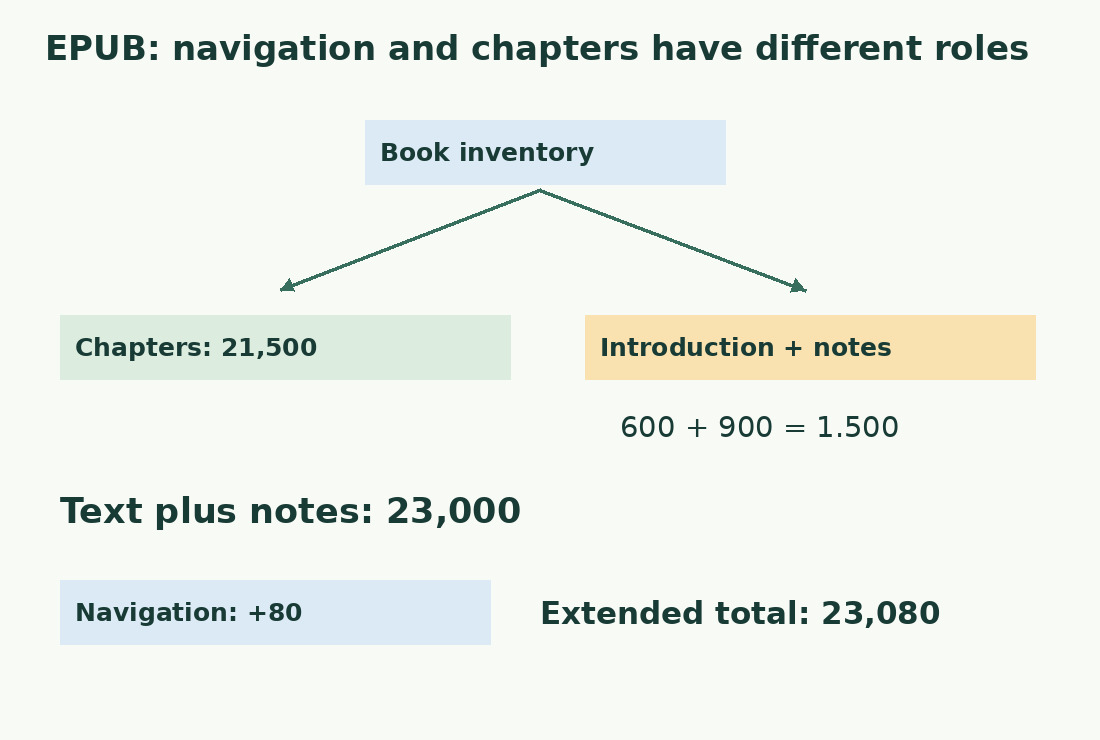
Take an invented ebook with chapters of 12,000 and 9,500 words, an introduction of 600 and notes of 900. Chapters alone total 21,500; adding introduction and notes gives 23,000. If navigation repeats 80 heading words, the extended total becomes 23,080.
These are illustrative figures, not a real book’s measurements. The 1,580-word difference from body to extended total is entirely explained by added components; it does not prove an error or hidden text. Use a section column and inclusion column for your own document to expose a missing chapter or note counted twice.
Check duplicates and reading order
Look for observable extraction problems: unexplained duplicate headings, missing paragraphs, words joined without spaces, notes interrupting sentences and reordered text. Do not normalize everything merely to force equal totals.
Compare a passage containing a note with the ebook. Moving it from the end of the book to after a paragraph can preserve word count while changing comprehension. Numerical agreement does not establish extraction integrity. Text within images needs another check: plain extraction may miss it. Identify those components and decide whether transcription belongs in scope. The counter does not perform OCR.
Reader screens are not publishing pages
Screen count changes with font and display size. Even reader pages or locations need interpretation before use in estimates or submissions. Estimating typeset pages requires explicit layout assumptions.
If asked for Italian publishing units called cartelle, count included characters and apply the agreed size in the cartella calculator. This differs from estimating printed pages. Do not present an estimate as a measurement of the printed book: dialogue and plates occupy different space from continuous prose with equal words. Keep the textual total to compare revisions independently of design.
Compare revisions on a constant basis
Keep a chapter sheet with previous and current totals and a reason. An increase of 350 words may be expected after adding a scene; investigate when the section should be identical. Check large and unexpected changes first and rule out missing material before chasing minor differences.
If content matches but counts differ, compare compound-word and punctuation conventions. The report should identify the extracted version, included sections and checked passages. That record keeps the number useful months later when the inclusion of contents or acknowledgments may no longer be obvious.
One ebook, three explained totals
| Example scope | Calculation | Words |
|---|---|---|
| Two chapters only | 12,000 + 9,500 | 21,500 |
| Chapters, introduction and notes | 21,500 + 600 + 900 | 23,000 |
| Text navigation also included | 23,000 + 80 | 23,080 |
Sources and checks
- W3C, EPUB 3.3 · EPUB resources, metadata, manifest and spine reading order.