Individual or combined?
“Maximum eight hundred characters each” applies separately; a short abstract cannot offset a long one. A combined limit needs defined components. Vita pensata illustrates individual Italian-summary and English-abstract limits. Other journals have their own rules. Make rows for language, text type, unit and ceiling, including bilingual titles, abstracts and keywords. Sharing a page does not imply sharing a threshold.
Count actual versions
Equivalent content does not preserve words or characters between languages. Measure every available version. Assumed expansion is only a labeled planning hypothesis, not proof that an untranslated abstract complies. Recount revisions by author or translator. Do not label a final translation with its original’s quantity. Source and translated text counts also matter for financial agreements.
Worked individual limits
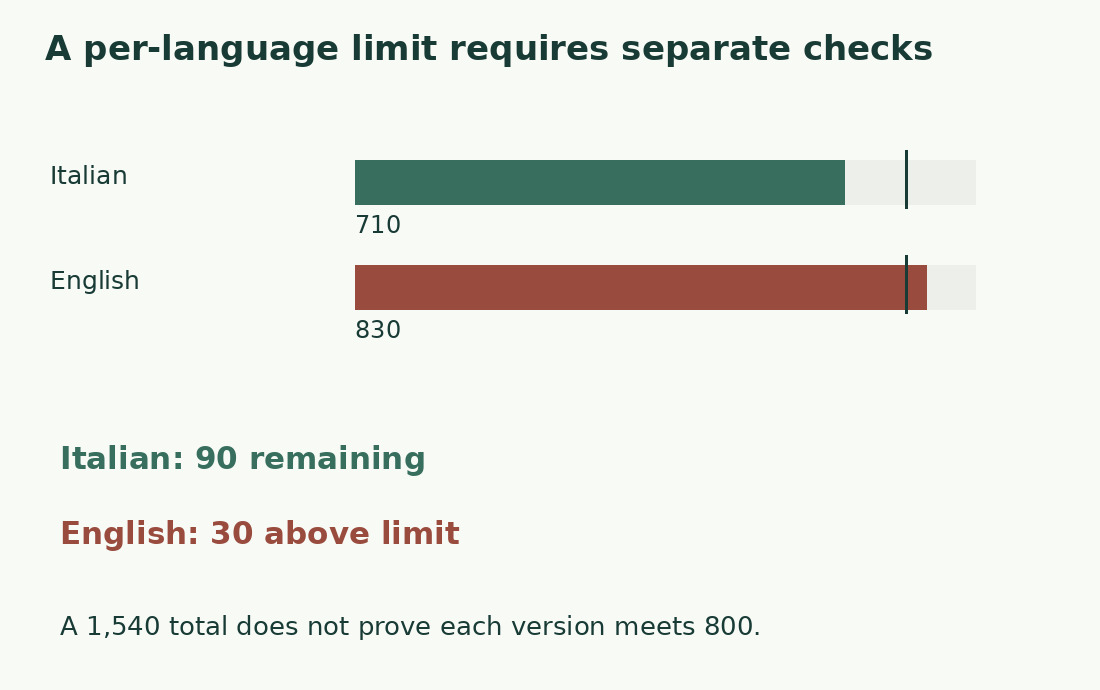
With an invented maximum of 800 per abstract, Italian at 710 has ninety available; English at 830 exceeds by thirty. Combined 1,540 is below 1,600 but does not make the pair compliant. Test every row against its own limit. Keep excluded titles/keywords separate and declare scope instead of adding or removing components silently to make the sum work.
Titles and keyword entries
A bilingual repeated title is actual text; inclusion follows instructions, not position or brevity. Keywords may be limited by entries rather than words. Five expressions need not mean five words: the literal Italian “storia dell’arte” can be one entry with multiple word-counter units. Retain both quantities where relevant. The counter measures strings; the recipient defines entries and presentation.
Compatible units
Body, translated title, other-language abstract and biography can share or separate scope; being in one file does not settle it. OPUS illustrates essay limits in characters and abstracts in words. Keep pertinent subtotals and form only requested sums. Do not add 300 words to 30,000 characters. A uniform aggregate requires all portions to be measured in the same unit.
Check parallel columns
Original and translation in adjacent columns may extract out of order or both enter a selection intended for one. Inspect opening, middle and ending per language. Prepare a verified plain-text copy of just the intended version for separate measurement. Numerical totals cannot establish extraction accuracy. The word counter cannot infer which language you wished to exclude.
Version consistency
Both abstracts can meet length while describing different essay drafts. After revising the body, align objectives, results and terminology across versions. Length does not evaluate translation accuracy: shorter is not automatically incomplete, longer is not automatically faithful. Competent reading is a separate check. Use the main document version as a shared reference and mark updated versus pending components instead of calling an unfinished package final.
Final record
For every component, retain language, file/section, version, unit, ceiling, result and relevant title/keyword inclusions. Put any aggregate on a separate row specifying what was added. Recount the changed version after the final correction and update package totals where needed; do not replace individual counts with a language average. The sheet should reconstruct every check while keeping translation quality, substantive completeness and other recipient requirements distinct.
An 800-character maximum for each version
| Hypothetical version | Characters | Individual result |
|---|---|---|
| Italian | 710 | 90 remaining |
| English | 830 | 30 above limit |
| Total | 1,540 | Does not replace per-version limits |
Sources and checks
- Vita pensata, norme redazionali · Per-language abstract thresholds and different units for essay and abstracts.
- Università di Chieti-Pescara, norme OPUS · Per-language abstract thresholds and different units for essay and abstracts.