SRT contains text and synchronization instructions
SRT associates text with time intervals. The Library of Congress describes sequence numbers, timing lines, text and blank cue separators. These are necessary for the file but are not all spoken or read words.
Pasting the complete file into a generic counter may include numbers and timings. A filename does not explain how to distinguish components. Our counter treats pasted content as plain text without extracting cues. Prepare a copy containing pertinent text only. Keep the original for synchronization and duration checks: removing timecodes from the counting copy does not justify removing them from video subtitles.
Choose the measure required
A quotation may use translated words, revision may need characters per subtitle, and exposure checks require visibility time. One total cannot answer all questions.
Set scope before extraction: dialogue alone or sound descriptions too. The exact Italian sample “[musica]” can be delivered content without being spoken. Speaker labels may follow another rule. Agree whether repetitions count: the same word in two cues can legitimately count twice. Lexical frequency differs from translation volume; deleting repetitions without understanding function can alter the assignment.
Extract without deleting valid content
For short files, process blocks: identify numbering and timing, then preserve subtitle lines. For long files use a text export with verifiable scope; procedures depend on your subtitle environment.
Do not delete every numeric line: a spoken date or code is valid text. Position and function distinguish it from a sequence number. Check the beginning, end and several middle cues. For formatting markers, establish actual displayed text and the representation the brief requires. Keep visible-text and formatted-source counts separate.
Dialogue and sound-label example
Retain exact Italian samples: “Domani partiamo presto.”; “Porta il quaderno” followed by a line break and “e una penna.”; “[musica]”. Our engine counts 3, 6 and 1 words: 10 including sound, 9 for dialogue only.
The difference is a component, not rounding. Report “sound descriptions included” so the client can reproduce it. For multilingual files, do not combine source and translation when measuring one language. Bilingual text can be right for video but outside the quotation’s scope.
State the line-break convention
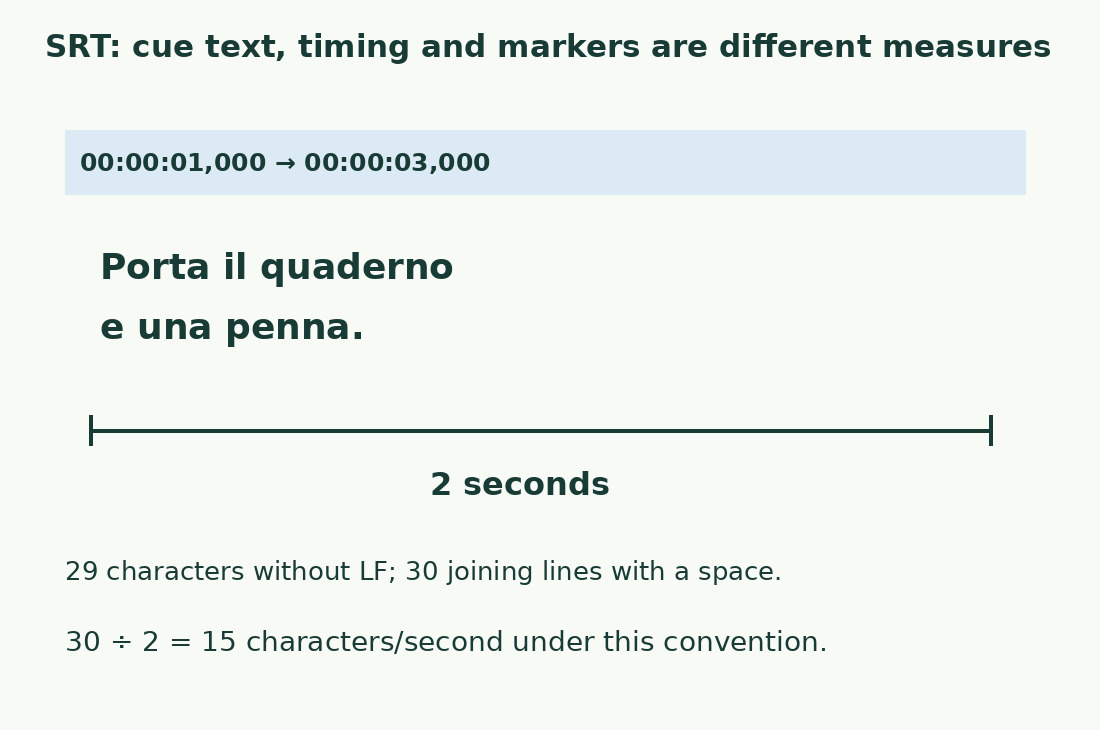
The lines “Porta il quaderno” and “e una penna.” contain 6 words. Our engine excludes line breaks from character totals, giving 29 including existing spaces. Joining with a space gives 30.
This was checked in our engine, not established as universal subtitle-software behavior. Before comparing limits, check interline separators, spaces and units for emoji or composed signs. If assessing individual lines, count them individually. One long and one short line can total the same as two balanced lines while reading differently.
Rate needs each cue’s duration
The joined 30-character sentence visible for 2 seconds gives 15 characters per second; for 3 seconds, 10. Text is unchanged; available time differs.
These illustrate arithmetic, not recommended thresholds. Apply platform or client requirements and review content. Numbers, unusual names and speaker changes can make equal-rate cues differently demanding. Our generic reading-time estimate does not use SRT timestamps and cannot replace synchronization checks. Audiovisual verification needs the video, text and actual timings together.
An average can hide a dense cue
One cue with 10 characters over 5 seconds and another with 30 over 1 give 40 ÷ 6, about 6.67 characters per second overall. The second alone is 30. A low average does not establish enough time for each subtitle.
Keep per-cue results when locating revision needs; the agreed text total may suffice for a quotation. Do not assign a whole video segment’s duration to one cue. Gaps and pauses can change overall averages substantially. Choose the question first and the denominator second.
Do not deduplicate subtitles like a list
Repetition may be a line spoken twice, a sign shown again or a cue split for the scene. Deleting equal lines automatically can change content.
Our duplicate-line tool processes lists under explicit rules; it does not reconstruct timings or verify dialogue. Use it only on a separate working list for recurring expressions, preserving the audiovisual original. Examine repetition in the video. Correct transcription in the appropriate environment and recount. String operations should not decide editing or accessibility choices.
Separate the report from audiovisual verification
Identify version, counted language, inclusions and line-break convention. For characters per second, explain duration and whether each cue or only an average was examined.
The word counter measures the cleaned copy. Its report describes content and engine rules, without certifying timestamps, audio correspondence or a subtitle guide. Keep corrected files with matching summaries. A precise count for an older version is unhelpful for the current delivery. Finish when text, timings and criteria have each been checked appropriately.
Words, characters and time measure different things
| Exact Italian example | Measure | Interpretation |
|---|---|---|
| Domani partiamo presto. | 3 words; 23 characters | One cue’s text |
| Porta il quaderno / e una penna. | 6 words; 29 characters excluding the break | Our engine excludes line breaks |
| Same sentence joined with one space | 30 characters; 2 seconds | 15 characters/second under this convention |
| [musica] | 1 word; 8 characters | Include according to the assignment |
Sources and checks
- Library of Congress, SubRip Subtitle format (SRT) · SRT cue numbers, timing, text and block separators.