Get the number from the destination
Check whether keywords belong in a portal field, below the abstract or in the document. Requirements may define entries, separators and languages. Entries are not individual words: a compound phrase may name one concept.
Argomenti, hosted by the University of Urbino, asks for two to six keywords in Italian and English relating to covered topics. This is a journal-specific rule, not a compulsory number for every thesis. If your course does not specify a number, prepare a reasoned proposal and ask the appropriate contact. Meanwhile identify central concepts developed substantively, rather than background-only mentions.
Extract concepts, not just frequent words
Read the research question, method and conclusion for distinguishing concepts. “Analysis” can be frequent but generic; an uncommon phrase may name the decisive method. Frequency is a clue, not an importance ranking.
The frequency analyser supports consistency and repetition checks but cannot recognise whether a word names a criticised theory, limitation or contribution. Build a larger candidate list. Note where each is developed, what it adds and which others cover similar ground. A term unconnected to substantive work probably does not merit a final slot.
A fictional project makes choices concrete
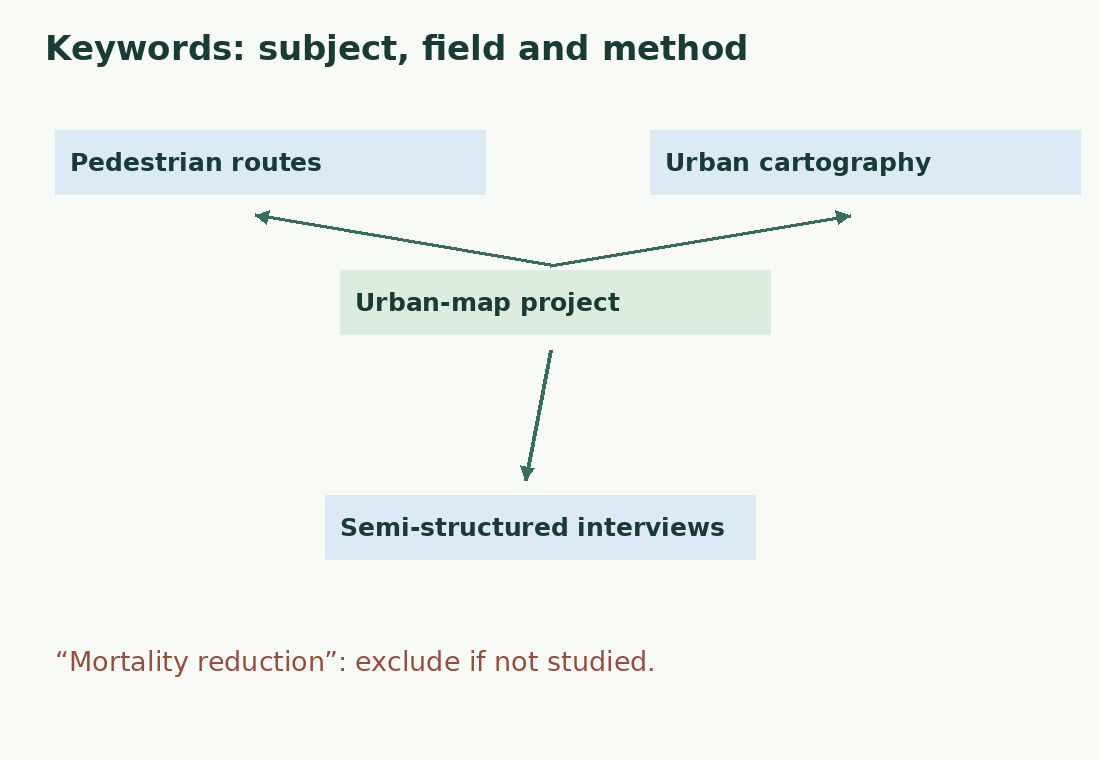
Imagine a thesis comparing three municipalities’ descriptions of shaded spaces on pedestrian-route maps, analysing maps and interviews with their makers. It neither measures temperatures nor observes residents’ movements. That scope defines plausible terms.
“Cities”, “environment” and “people” are related but undistinctive. “Pedestrian routes”, “urban cartography” and “climate-risk communication” may fit if developed. “Semi-structured interviews” applies only if that is the actual method, not because it sounds specific. “Mortality reduction” misleads if the outcome is unstudied. An urban-heat theme does not authorise every possible consequence.
Balance broad and distinctive terms
A broad word locates the field but may not distinguish the contribution. An extremely specific phrase may describe the case yet help little if the discipline does not use it that way. Check field vocabulary and destination guidance.
Use terminology in relevant academic sources actually consulted, without copying their keyword lists. Follow a controlled vocabulary if required; otherwise maintain consistent free terms. Do not suggest research into public preferences when analysing institutional documents. Context can locate a field but must not imply absent methods or populations.
Make each entry add information
Compare candidates in pairs. “Urban maps” and “urban cartography” may spend two slots on nearly the same concept. With a tight limit, choose the better term and add a different dimension. Retain close terms only when they distinguish real objects or approaches.
“Pedestrian routes” is two words but can be one entry. Verify whether a five-keyword requirement means five entries and which separators apply. An ordinary word count cannot settle that requirement. Avoid singular/plural, spelling and acronym/full-name duplicates without distinct meaning. Expand unfamiliar acronyms unless the field or system calls for another convention.
Align meanings between languages
A literal translation may differ from the disciplinary equivalent or change semantic scope. Check specialist sources for actual usage.
A terminology table can record source term, proposed equivalent, reference and unresolved doubt. Present disputed alternatives to the supervisor with their difference instead of declaring unchecked translation final. Align keywords with the abstract: if one version describes document analysis and another an experiment, fix content first. Terminology review accompanies scientific and linguistic checking without replacing it or implying approval.
Check every final entry
Ask whether each is developed, adds a distinct dimension and follows the format. Remove unsupported terms, reconsider duplicates and clarify unknown conventions.
Read the list alone: does it suggest the actual work? Then compare with the title. A new term can add information, but no rule forbids all repetition. Accuracy matters more than artificial variety. After portal entry, check separation, accents and translations. Save the list with the final abstract and revisit it after contribution changes. It should describe completed research rather than its initial idea.
Selecting terms for the fictional map project
| Candidate | Assessment | Required check |
|---|---|---|
| Cities | Very broad | Does it add a dimension? |
| Pedestrian routes | Potentially distinctive object | Is it developed? |
| Urban cartography | Relevant field or approach | Does it duplicate another term? |
| Semi-structured interviews | Possible method | Was this method used? |
| Mortality reduction | Outside the case | Remove if the outcome is unstudied |
Sources and checks
- Argomenti, Università di Urbino: norme per gli autori · Local two-to-six keyword requirement in Italian and English, describing covered topics.