Choose a question the number can answer
A frequency check can reveal a word concentrated in one paragraph, an overused construction or a recognisable service name. It cannot answer “Which percentage will rank first?” Search results offer conflicting ideal ranges; do not turn them into Google rules. Google describes unnatural repetitions used to manipulate results, without an arithmetic threshold automatically making wording safe or helpful.
State the intended use before counting. Analyse a paragraph for local repetition and the body for article vocabulary. Including menus and footers changes frequency even if the main content stays identical.
A single-word calculation
In a constructed 1,000-word text, 20 occurrences of “booking” give 20 ÷ 1,000 × 100 = 2%. This reports occurrences relative to words, not whether they are close together, necessary or well distributed.
Add 1,000 irrelevant words, retain the same 20 occurrences and the percentage becomes 1%. The denominator grew while the editorial issue remained. Conversely, a short instruction may need to name a document twice to prevent ambiguity. Its percentage is high because it is short. Consider function, spacing and audience knowledge rather than replace a necessary name with an inaccurate synonym.
State a phrase denominator
For the literal Italian example sala studio
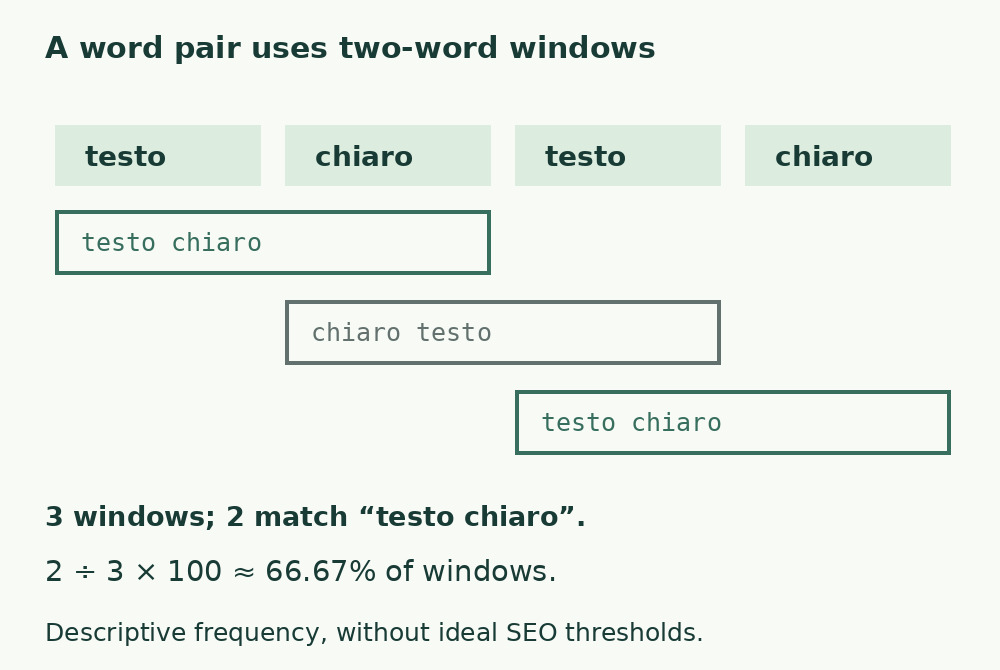
, tools may divide occurrences by total words, count words occupied by the phrase or use possible two-word sequence positions. These are different measures.
One 100-word sentence contains 99 contiguous two-word windows. Five occurrences give 5 ÷ 99 × 100 ≈ 5.05%. Five divided by 100 words gives 5%; the ten words occupied by five phrases give 10%. Label the criterion.
Do not create absent phrases. Removing e
from sala e studio
before forming pairs invents sala studio
. In the keyword analyser, common-word filtering must preserve original adjacency. Check any tool’s methodology.
Turn counts into editorial decisions
Read occurrences and classify them: topic definition, interface label, reference clarification or unnecessary repetition. That identifies changes preserving accuracy.
If a paragraph starts and ends with the same promise, try deleting the second statement. If every sentence repeats a keyword despite different steps, see whether the subject can safely remain implicit. Keep technical terms distinguishing quantities even when frequent. Do not automatically substitute synonyms: an Italian publishing cartella
, a page and a sheet can be different objects; words and characters are different units. Lexical variety cannot compensate for lost precision.
Compare like with like
Keep scope and method consistent across versions. Record whether titles, captions, bibliography and menus are included. An added useful section can lower a percentage without removing an occurrence; disclose that.
A competing page may repeat a term because of a glossary, catalogue or table you lack. Matching its percentage does not reproduce its value. Inspect questions answered, results shown and mistakes prevented. Related terms need correct relationships too: a word list alone neither demonstrates completeness nor explains which concept readers need.
Report honestly
A useful note says “The term occurs 20 times in 1,000 words; nine are in one paragraph; four repeated definitions were removed.” It connects data to a verifiable edit. “Density optimised to 2%” conceals reasoning and implies an arbitrary target.
Read continuously afterward. Are remaining repetitions justified, references clear and added sentences useful? These questions expose edits improving the number but worsening content. Search usefulness also requires accurate facts, task completeness, working tools and readable structure. Density alone measures none of these and cannot establish future rankings.
Use a repeatable sequence
Select text, choose a unit, inspect concentrations and record each decision. Recalculate after editing. Clearer wording preserving information gives a reason to keep the edit even outside another service’s suggested range.
If the table produces no useful edit, do not force one. It may confirm appropriate use of the topic’s name. Check something more relevant, such as a numerical example or procedure step.
One key phrase, three measures
| Method | Calculation | Result |
|---|---|---|
| Occurrences per 100 words | 5 / 100 × 100 | 5% |
| Words occupied by the phrase | 10 / 100 × 100 | 10% |
| Two-word windows in one sentence | 5 / 99 × 100 | about 5.05% |
Sources and checks
- Google Search Central: norme sullo spam · Qualitative keyword-stuffing definition, without a safe density percentage.