Do not start with a thesaurus
An application guide will often repeat “application”. Alternating “request”, “paperwork”, “case” and “submission” can imply different objects. Repetition helps maintain a stable reference.
Conversely, “The service is simple”, “The process is easy” and “You can use it without difficulty” repeat one claim with different words. A lexical counter may miss this, whereas a meaning review will not. Decide whether you seek nearby repeated nouns, a formula opening every paragraph or the same concept explained repeatedly. A frequency table locates material; it is not an automatic error list.
Count relevant material
Menus, footers and buttons can dominate a whole-page list. Analyse the article body for an article edit, or retain interface labels when those are the target. Scope must match the task.
The frequency analyser compares words and expressions. Two- or three-word phrases reveal constructions such as “in this case” even when other vocabulary varies. Common-word filtering makes the list easier to inspect but does not change the text or determine importance. Turn it off when recurring conjunctions or pronouns may reveal a stylistic or grammatical pattern.
Distinguish forms and meanings
A case-insensitive counter can combine “text” and “Text” but keep “texts” separate. This differs from linguistic analysis grouping grammatical variants. Check units before comparing tools.
One form can mean different things: the source’s Italian stato
can refer to a condition or state institution. Counts cannot resolve that; read the sentence around each important occurrence. Lexical diversity is distinct forms divided by total words. A constructed 10 forms in 20 words gives 50%; 100 in 200 gives the same. Equal ratios do not establish equal vocabulary, quality or difficulty. Length and genre affect interpretation.
Choose an action for each occurrence
- Keep terms needed to recognise an object.
- Delete repetitions adding no information.
- Replace only with equally accurate, unambiguous wording.
- Reorganise the sentence if construction causes the problem.
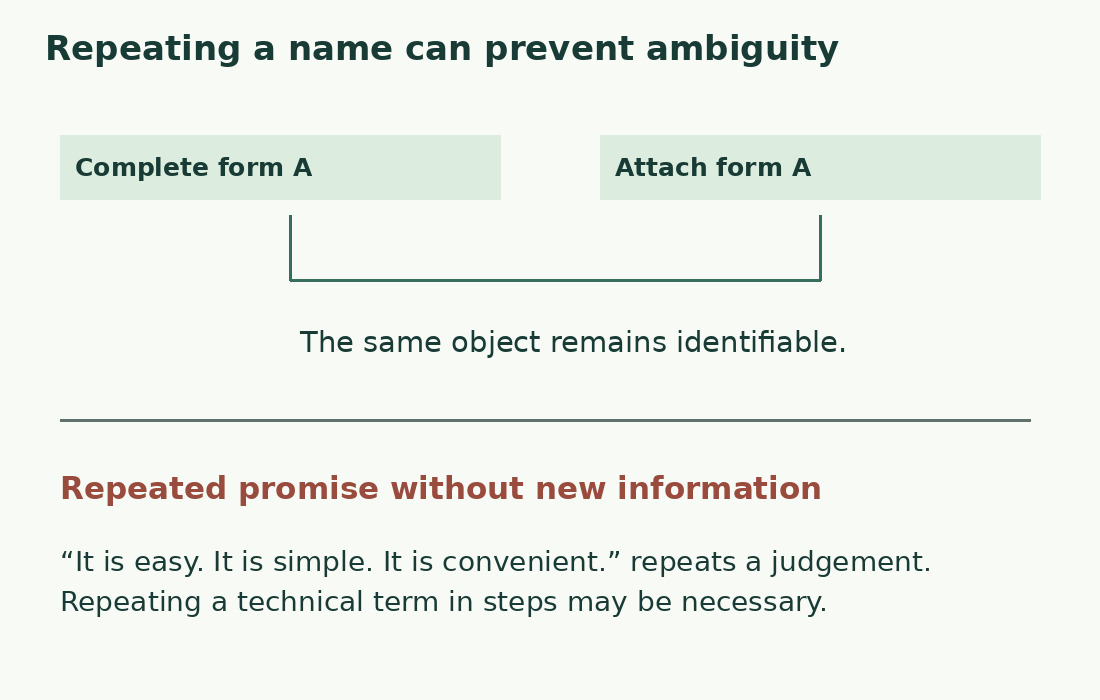
“Open the form, complete the form and submit the form” can become “Open the form, complete it and submit it” because one referent is nearby. Introduce a declaration to sign between those actions and a pronoun may become ambiguous; repeating “form” can be safer. Technical synonyms must not broaden or narrow concepts: “characters”, “letters” and “words” measure different things. Accuracy comes before variety.
Look at distance, not just totals
Ten occurrences across a long guide differ from ten in one paragraph; totals hide this. Inspect concentrations and ask whether every sentence adds a new step.
Intentional repetition can teach: name a value again before interpreting it or recall a document where it must be attached. Moving every explanation to the introduction can harm readers consulting one section. Remove generic reminders without a function. Replace repeated “Check the result” with the particular check—rounding for price, pauses for duration—or delete it. Specificity also prevents repetition of thought.
Reread after cutting
Recount the same scope after edits. Fewer occurrences prove only changed distribution of forms. Read adjacent sentences for lost references, confused categories and tone changes.
Read aloud at normal speed to notice monotony or stumbling. For reference material, also read headings and isolated sections: repetition intrusive in continuous reading can support partial access. Record a reasoned example: “Retained the form name to distinguish it from the declaration.” “Reduced density” supplies a number without explaining reader benefit.
What frequency cannot promise
Low frequency does not prove originality and high frequency does not prove copying. Borrowed ideas can use different words; a subject may legitimately need one repeated term. Attribution needs separate review.
No universal percentage makes repetition correct across glossaries, notices and stories. Use counts to select passages, then judge the genre. Consider confidentiality when choosing an analysis route: this project counts in the browser, but another service may differ. An invented passage retaining the construction often suffices for discussion with a colleague instead of sharing the real document.
The same frequency can justify different decisions
| Observed repetition | Possible function | Action to consider |
|---|---|---|
| Form name in several steps | Keep a precise reference | Retain where ambiguity could arise |
| Same promise in three sentences | Repeat a concept | Cut or add information |
| Same opening in every paragraph | Structural habit | Rewrite construction |
| Required technical term | Use the accurate name | Explain without changing the concept |
Sources and checks
- Corpus Italiano: analisi del testo · Type–token ratio definition, not a quality threshold.