Choose a specific problem
“Make this simpler” is too broad for a first edit. You might shorten every word while leaving it unclear who must send the form. Identify an observable obstacle: readers cannot find the deadline, confuse two requirements or mistake an option for an obligation.
Write the question the passage must answer: “Do I register before choosing a room?” Locate the answer and information needed to apply it. If it is scattered across three paragraphs, revise order before vocabulary. A useful revision can be shorter after removing a preamble or longer after adding an essential explanation. Judge length against the task, audience and consequences of misunderstanding.
A before-and-after example you can check
The invented Italian wording is retained because counts depend on exact text: Al fine di consentire la prenotazione della sala, gli utenti che non abbiano ancora effettuato la registrazione sono tenuti a procedere alla compilazione del modulo disponibile sul sito prima di inoltrare la richiesta.
It says unregistered users must complete the website form before submitting a room-booking request, using several extended constructions.
The shorter Italian version is Per prenotare la sala, registrati sul sito. Compila il modulo prima di inviare la richiesta.
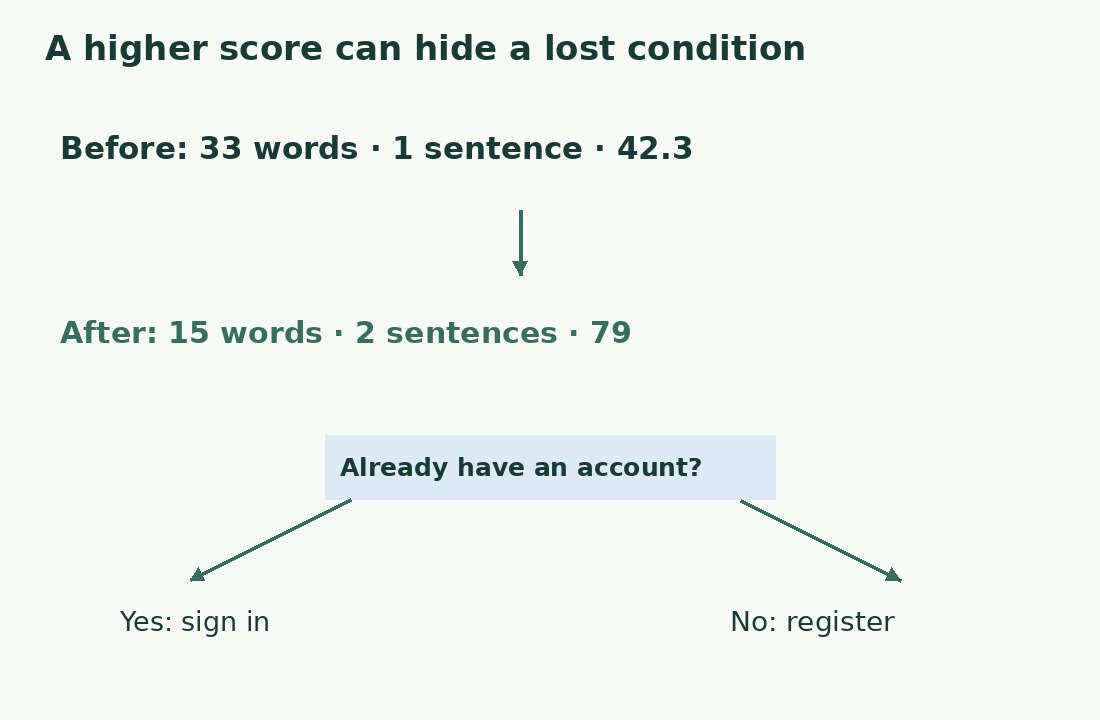
This means “To book the room, register on the website. Complete the form before submitting the request.” The engine counts 33 words and one sentence in the original, 15 words and two sentences in the revision. Their Italian Gulpease scores are about 42.3 and 79. These short samples illustrate arithmetic, not a statistical comprehension study.
The edit loses a condition: the original requirement concerns unregistered people. If existing users go straight to the form, add “If you already have an account, sign in and open the form.” Without it, the shorter wording changes the procedure.
Revise order before sentences
Work at three levels separately. On the page, put the answer before supporting details. Within a paragraph, keep one topic. Within a sentence, clarify relationships between conditions and actions. Changing everything together makes new ambiguities harder to trace.
An application page might cover eligibility and deadline first, then documents and procedure, then exceptions and help. A “Documents” list should contain documents rather than papers mixed with opening hours and notices. Only then shorten “carry out the submission” to “submit”. This is not a ban on nouns: “submission date” can be an effective label. Choose forms for their function rather than replacing every occurrence mechanically.
Keep necessary terms and conditions
A technical term may identify a document or explain a result. Keep it when accuracy matters and explain its first use briefly. A “receipt” and a “booking confirmation” may be different files.
Place conditions before affected actions: “If you are under 18, also attach…” is easier to apply than a distant exception. Check negations, ranges, dates and limiting words such as “only”, “at least”, “by” and “unless”; moving them can change meaning. Give necessary details their own lines or a requirements list rather than deleting them. For different groups following different routes, introduce a matrix explaining which row to choose.
Work within a character limit
Edit a copy and use the character counter after significant changes. First remove information belonging to another step, then shorten inflated constructions. Removing articles and prepositions first can produce cryptic wording.
Decide what must remain visible and what can sit behind a clearly described link. A condition changing an immediate action belongs beside it; a supplementary example can be secondary. Include a real, usable support contact or channel for people unable to follow the digital route. A shorter message forcing a longer search has not solved the task.
Check comprehension and counts separately
In the readability check, compare estimated sentences and average length. Gulpease is specifically for Italian. A large score change may reflect an abbreviation or heading counted as a sentence rather than a clearer explanation.
Walk through the task using only the page. For every action, identify where it happens, what information it requires and what confirms success. Add knowledge a newcomer would otherwise need to supply. Ask a target reader “What must you do?”, “By when?” and “What if this requirement is missing?” Do not suggest answers or explain ambiguous wording aloud. Uncertainty is evidence for revision, not a reader’s fault.
Know when to stop
Stop when the text enables the task, preserves relevant conditions and avoids unnecessary outside explanations. Do not chase endless score increases: explaining a long term may add words and still improve the text.
Keep the original, final version and change notes. Check the published title, links and layout. A necessary link far away, or an exception difficult to read on a phone, can make otherwise clear sentences hard to use.
A better number still needs a meaning check
| Original Italian | Short Italian version | Editorial check |
|---|---|---|
| 33 words; 1 sentence; Gulpease 42.3 | 15 words; 2 sentences; Gulpease 79 | Check the route for existing users |
| Requirement for unregistered users | General instruction to register | Add the existing-account condition if applicable |
Sources and checks
- Designers Italia: linguaggio · Clear words, simple syntax and explicit actions.
- W3C WAI: clear and understandable content · Clarity involves vocabulary, structure and context as well as a numerical index.