Define the task the text must enable
Start with the person’s goal: book, request, correct, withdraw or find an outcome. “Inform service users” describes an office’s intention but not what readers need. They must know whether the procedure applies and what to do first.
Summarise the action in a working copy: “Apply to use a municipal room.” List eligibility, deadline, channel, attachments, cost and exceptions separately from surrounding formulas. Simplification does not change a service: a required signature or second route cannot disappear to save space. Editors control presentation; the content owner checks the underlying facts.
Name the actors
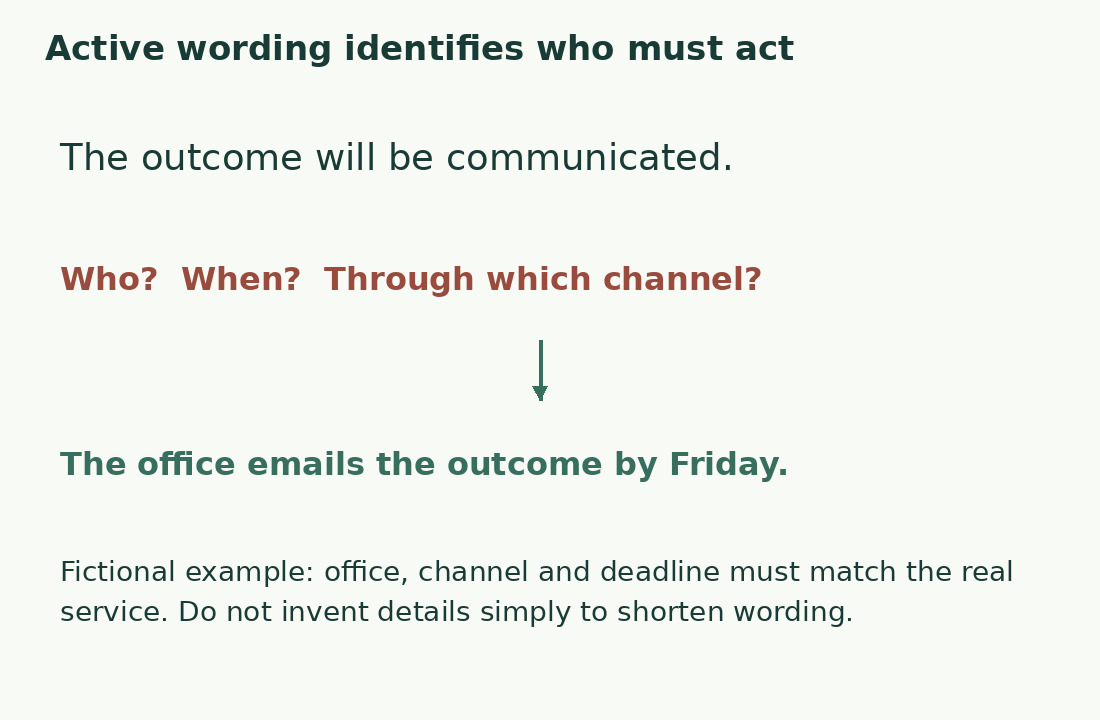
“The outcome will be communicated” leaves unclear whether people receive a message, check a page or contact an office. “The office sends the outcome to the address on your application” names actor and channel. This invented example applies only if it describes the actual service.
“Attach the document” is more direct than “The applicant is required to produce the document”, but a service notice and formal regulation allow different levels of rewriting. Do not alternate “user”, “resident”, “interested party” and “applicant” for one person without reason; readers may infer different roles. Keep an appropriate stable term and explain real distinctions, such as the authorising person and representative.
Shorten constructions accurately
“Carry out completion” can often become “complete”, and “proceed with submission” can become “submit”. Use the space for which form, where it is and what happens next. This is not a ban on nouns: “submission date” can be the right label.
A replacement list cannot rewrite a procedure. Everyday wording may replace a formal term in prose, but retain the official document name where readers must find a file. Designers Italia recommends understandable words and direct syntax. Apply that to the actual audience: a familiar technical term may be clearer than a long paraphrase. Ask whether this reader knows what to do, not whether a word is always forbidden.
Place conditions beside affected actions
“Only” matters when it restricts a channel. “You can hand in the application at the counter” and “You must hand it in only at the counter” describe different services. Highlight words limiting options, obligations and eligibility before editing.
Put the condition first: “If applying for someone else, attach their authorisation.” A condition after a long list can make people prepare unnecessary documents or omit a required one. For two or three routes, use a case/action/document table if helpful. Give each cell usable information rather than “as above”, and explain which row to choose.
Make dates and references verifiable
“By the specified deadline” works only if the date is immediately available and unambiguous. State date and relevant time, checking time zone or channel for international audiences. “Tomorrow”, “soon” and “this year” age badly on lasting pages. Use stable references; do not change dates merely to suggest freshness.
Check that “Form A” has the same name on the page and file. Article numbers must point to the correct source. Link the full text and distinguish a public-facing operational summary from the original provision.
Review facts with the service owner
Record old wording, proposal and required check. “The office will provide a response” might become “You will receive an email”, but the new channel needs confirmation. Clarity does not authorise a new commitment.
Ask “Is a receipt also sent for incomplete applications?” rather than “Is this sentence OK?” The precise answer allows a useful limitation. The sentence analysis can compare wording, with Gulpease specifically measuring Italian, but also walk through the task. Readers must find the first action, know when finished and have a route when something fails.
Check the published page
A working document can become confusing online through a generic title, “click here” link or exception far from a button. Inspect the layout on the audience’s main device.
When a service changes, search for the old channel across the page, confirmations and linked files. Consistency matters more than polishing only the introduction. Record who checked facts and which conditions were verified. Repeated support questions identify passages worth investigating. Do not automatically add a FAQ: correcting the main instruction may better resolve uncertainty. Verify the effect on that task.
Clearer wording must remain true
| Check | Question for the owner | Risk without checking |
|---|---|---|
| Actor | Who sends the outcome? | Hidden responsibility |
| Channel | Is the reply sent by email? | A promise the service does not meet |
| Deadline | Which date and time apply? | Late submission |
| Exception | Who must attach authorisation? | Missing or unnecessary document |
Sources and checks
- Designers Italia: linguaggio · Simple syntax, active constructions and understandable terminology.