Decide why the sentence needs work
A long sentence is not automatically wrong: it can express a complex relationship more accurately than disconnected short sentences. Revise when readers backtrack for the subject, two conditions appear to govern the same action or decisive information is buried in parentheses.
The tool flags sentences over 25 words for rereading. That is a project review threshold, not a grammar rule or guarantee of difficulty. An 18-word sentence with three negatives can demand more effort than a familiar 30-word list. Note the actual problem first: a late condition needs a different edit from too many actions. Use the sentence and readability check to select passages, then examine their relationships.
Map actor, action and constraints
Find the main verb and its actor. Identify when, where, with what and under which conditions the action happens. A deadline can change behaviour; historical background can often be separated.
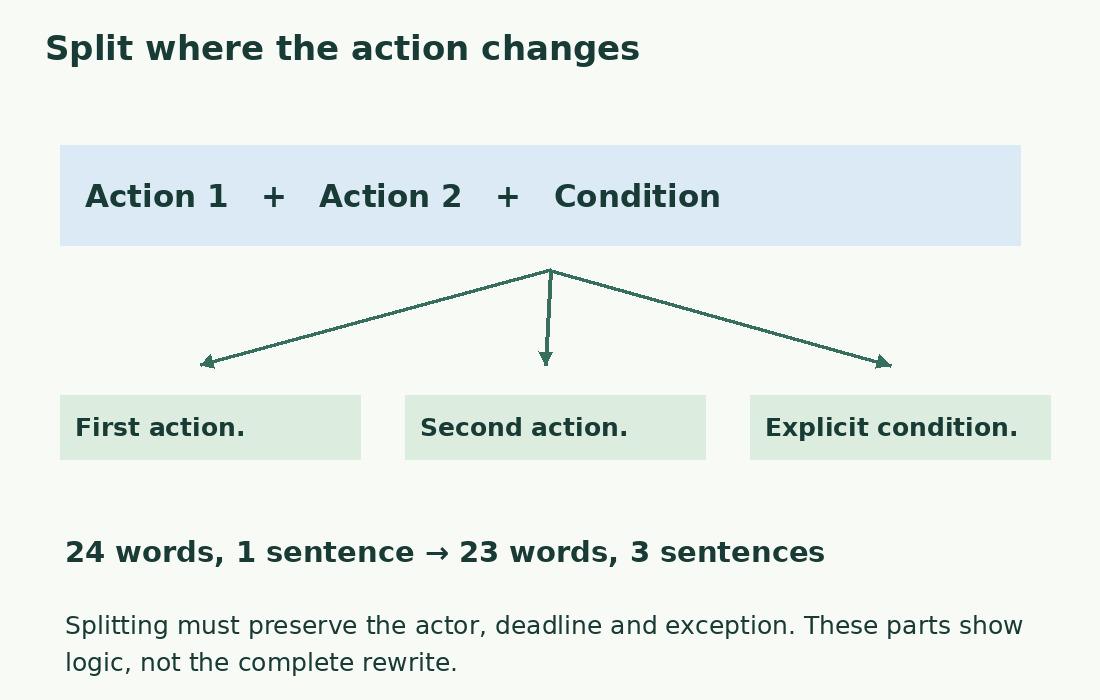
For reproducible counts, keep this invented Italian sample: La domanda, che deve essere firmata dal richiedente e accompagnata dal documento indicato nel bando, va inviata entro venerdì, salvo proroghe comunicate sul sito.
It combines application preparation, submission by Friday and any extension announced online. The central clause interrupts the application–submission link.
The revised Italian is Firma la domanda e allega il documento indicato nel bando. Invia tutto entro venerdì. Controlla sul sito se il termine è stato prorogato.
In English: “Sign the application and attach the document specified in the notice. Send everything by Friday. Check the website for an extension.” The sequence still needs an operational check: an extension should be checked before submitting, so a useful version may start with the current deadline.
Do not invent a sequence
Show order when actions must be consecutive. For parallel actions, do not add “then”. “Attach the document and sign the application” does not establish which comes first. A tidy edit must not create a new requirement.
Use numbered lists for intentional sequences and bullets for independent requirements. Three documents may need bullets; opening, completing and submitting a form require order. Separate alternatives before their actions: “If applying online…” and “If submitting at the counter…” let readers skip the irrelevant route and its exceptions.
Restore references after the full stop
Splitting can leave a pronoun without a clear antecedent. “This must be signed” is unsafe when application, declaration and receipt all appear. Repeating a noun may be more useful than avoiding repetition.
Check that “therefore”, “however” and “in that case” express real relationships. Keep exceptions close to promises: “The service is free. Paper copies incur a charge.” Review double negatives too. Changing “People who do not have… are not admitted” to “Only people with… are admitted” requires context: a necessary condition may not be sufficient for admission. Do not broaden a promise while simplifying syntax.
What the example counts show
The original Italian has 24 words, 135 letters and one sentence under the engine’s rules. The three-sentence version has 23 words and 112 letters. The Italian Gulpease score rises from about 45.3 to 79.4. These samples are too short for a general comprehension claim.
Word count hardly changes; the architecture brings actions closer to objects and reduces interruptions. Do not infer a required number of full stops. Artificial fragments such as Porta. Il documento. Firmato.
(“Bring. The document. Signed.”) may improve a calculation while producing unnatural instructions. Read the text as published.
Review in four passes
- Check who acts, what they do and every constraint.
- Check relationships between sentences.
- Read aloud without rushing difficult points.
- Check the heading, list, link and exception placement.
A necessary official name or quotation may keep a sentence long. Introduce or explain it rather than altering quoted text. Distinguish your summary from faithful quotation. W3C’s succinct-text guidance allows checking whether one long sentence is clearer than two short ones. Keep the previous version until relationships, terminology and responsibilities have been checked against the task.
Leave a useful review note
Record the problem, change and outstanding check: “Preparation interrupted the submission rule; actions were separated; the place to check an extension still needs verification.” This says more than “sentence simplified”.
It distinguishes a stylistic proposal from an approved procedure. A service expert checks facts while the editor checks connections. The counter supports observation and comparison; accuracy still needs a content review.
Structure changes as well as length
| Italian example | Words | Sentences | Gulpease |
|---|---|---|---|
| Original application sentence | 24 | 1 | 45.3 |
| Three-action version | 23 | 3 | 79.4 |
Sources and checks
- W3C WAI: Keep text succinct · Text splitting and the need to verify whether the result is clearer.