Start with the reader
A notice for families and a specialist report may contain the same difficult words but require different explanations. Identify what readers already know and what they must decide. Write a task beside the draft: “The person must know whether they can book and which documents to bring.” Reaching 80 is less useful if the booking date is missing.
People on phones, returning readers and those seeking a deadline may scan rather than read every sentence. Informative headings, explicit references and predictable order matter independently of the formula. Use the score to locate passages worth reviewing.
What the formula counts
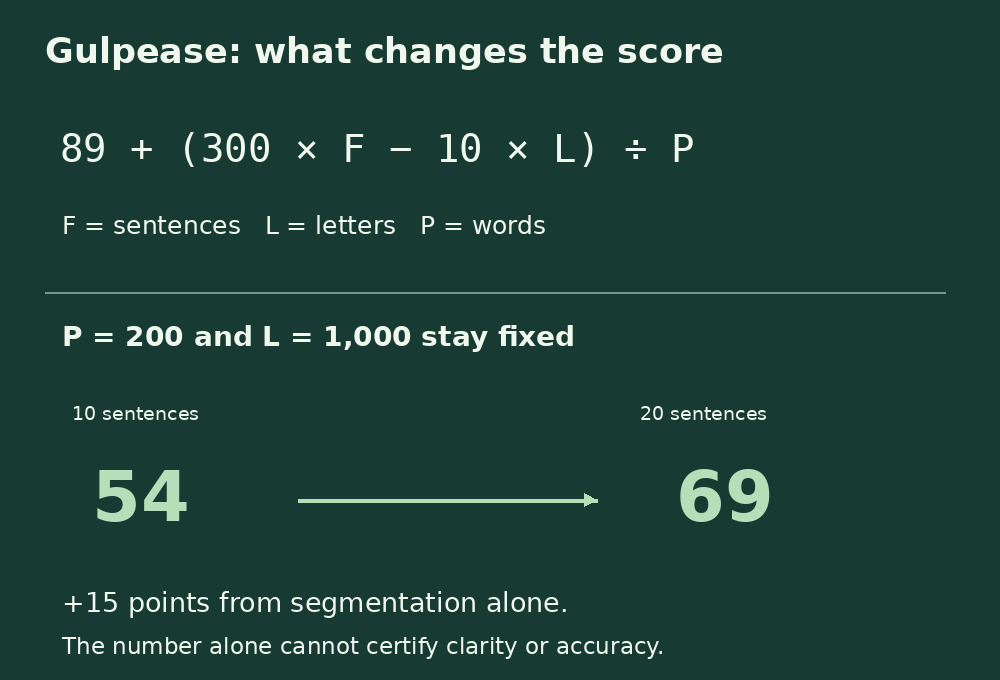
The formula is 89 + (300 × sentences − 10 × letters) ÷ words. Spaces are not letters. Tools must decide what constitutes a word and where sentences end. Abbreviations, lists and headings can change their counts. Our Gulpease calculator displays its inputs. Check estimated sentences before assuming a different result means greater accuracy.
In a hypothetical arithmetic example, 200 words, 1,000 letters and 10 sentences produce 54: 89 + (3,000 − 10,000) ÷ 200. Count 20 sentences with the same words and letters and the result becomes 69. Segmentation alone explains the change.
Read thresholds as references
Traditional Italian school-level references are 80 for primary education, 60 for lower secondary and 40 for upper secondary. A score below a threshold suggests difficulty for that level; it does not classify an individual reader. The hypothetical 54 is below 80 and 60 but above 40. Subject knowledge and familiarity with a service or trade can change actual understanding.
Avoid “suitable for everyone”, “for children” or “guaranteed readability”. Report observable work instead: “We reviewed long sentences and explained procedure terms.” A score cannot support a universal comprehension promise.
When the number says little
A three-word caption may score highly and a list of technical names poorly; neither behaves like continuous prose. Assess genre before comparing samples. Required names of diseases, documents or institutions may be long. Keep the accurate name and explain it rather than replacing it with an inaccurate short label.
The raw formula can exceed 0–100. Our tool retains the value and caps only the bar marker. This literal Italian sample, La casa è blu. Il giardino è verde., yields 8 words, 26 letters and 2 sentences: 131.5. The bar stops at its visual maximum and the panel flags the short, unstable sample. Do not use it to certify quality.
Define the sample
For a long document, analyse everything or state a consistent sampling rule, such as introduction, main instructions and exceptions. Do not select only the best-scoring paragraph. Menus, tables, button labels and prose serve different purposes: analyse instructions separately when revising them, but keep the same scope when comparing page versions.
Record inclusions and exclusions so a colleague can reproduce the sample after an update. If a new section was added, disclose it: the comparison includes a content change as well as a rewrite.
Compare versions usefully
Use the same content and counting rules; do not add or omit headings merely to improve the number. Save both versions and record changes: sentence splitting, an explicit subject, a shorter construction or a newly stated condition.
Then reread without the score. Check deadlines, the person responsible, references such as “this” and retained exceptions. Restore necessary words even if the score falls. Ask a target reader what they would do next without coaching. A wrong answer identifies a task problem; one reader’s feedback is not general validation. Record the doubt and check the next revision.
Document the editorial check
Keep the text or version, counting method, result and changes. State choices such as “Subheadings included; bibliography excluded; abbreviations checked.” This makes the check repeatable.
Gulpease alone cannot certify compliance with accessibility standards, assess a diagnosis or assign an individual school level. It is a reproducible observation of some formal obstacles in Italian text, useful alongside a content review.
One sample, two segmentations
| Hypothetical data | 10 sentences | 20 sentences |
|---|---|---|
| Words | 200 | 200 |
| Letters | 1,000 | 1,000 |
| Calculated score | 54 | 69 |
Sources and checks
- Corrige.it: l’indice Gulpease · Formula and challenges of automatic sentence segmentation.
- Corpus Italiano: readability · Traditional Italian school-level interpretation thresholds.