Equal counts can hide different experiences
Two 1,200-word articles can offer opposite experiences. One answers promptly, shows an example and explains an exception; another repeats background and delays the result. Equal counts provide unequal help.
Define a checkable task. “Understand whether thesis notes count” needs inclusion criteria and a software or rules check. “Write about theses” can expand indefinitely. Google’s helpful-content guidance says it has no preferred word count. An internal minimum is not a Google requirement. If a series requires a minimum, be willing to merge or reconsider topics that cannot justify it.
Map coverage before outlining
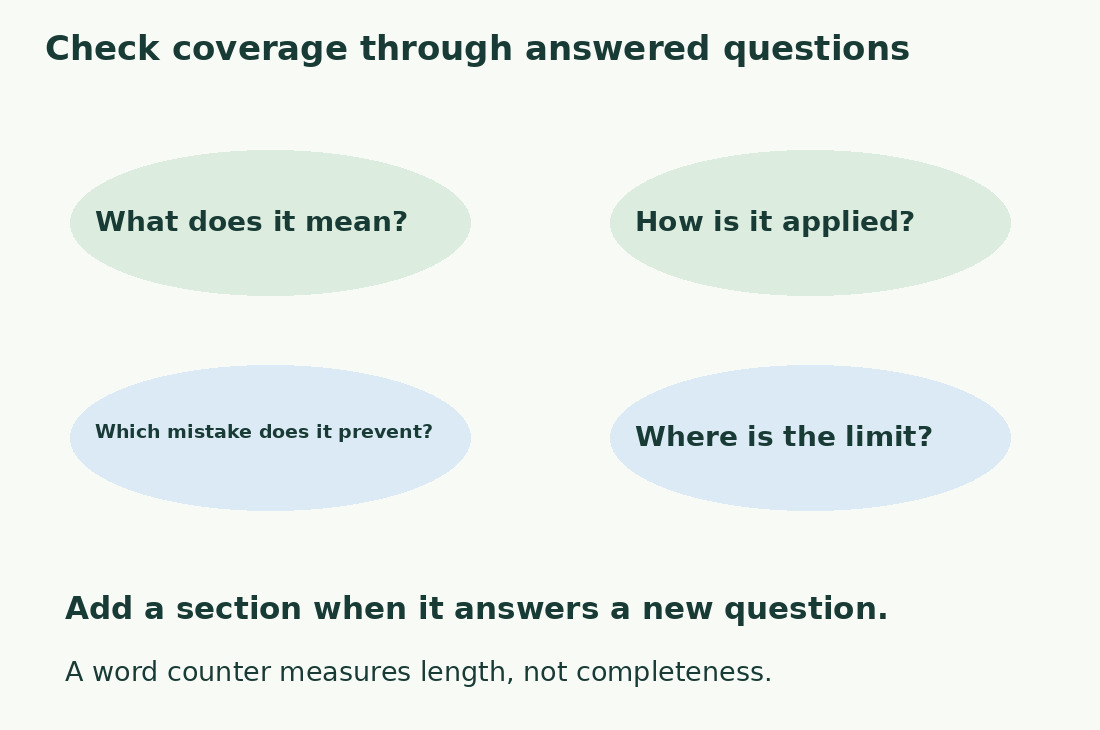
List questions blocking completion. Words-to-minutes conversion may need speed, pause handling, slide allowance and estimate verification. These do not all require separate pages.
For each question, identify a needed explanation, source, worked example or product test. “Show what changes when two minutes are reserved for questions” exposes a useful gap more clearly than “add three sections”. Put the answer first, then method, outcome-changing cases and limits. Link lateral topics where they justify independent guides. A complete answer to one task need not contain everything known about its subject.
Use examples supporting decisions
Useful examples show likely mistakes. Italian publishing units of 1,800 and 2,000 characters yield different quantities and estimates. Including the title can change submission eligibility under a word cap.
State inputs, calculation and interpretation, with assumptions beside results. Five examples changing only the initial number may work better as one compact table. Use remaining space for a case where the method fails. A real software screenshot can replace orientation prose if it shows the correct environment and control; decoration cannot supply missing explanation. Choose text, tables and imagery for understanding rather than word count.
Verify facts rather than collect citations
Use a primary source to verify a particular limit or behaviour and claim only its support. One course’s rules do not establish national thesis standards. Adult English silent-reading research does not establish universal speaking speed in another language.
Original value can be a case comparison, checking procedure or verified example. Expanding an existing page in different words is insufficient if readers still lack essential steps. Where a source is inaccessible or data unconfirmed, state the limit and narrow scope instead of inserting plausible figures. Focused accuracy can help more than unsupported breadth.
Identify cuts by function
Assign each paragraph a role: answer, explanation, evidence, case, limitation or next action. Try deleting passages without one. General background about everyone writing more rarely helps an imminent submission.
Find repeated ideas despite varied words. Two paragraphs on quality over quantity may need one statement and a concrete decision. The word counter measures reduction; meaning determines its value. FAQs help when they answer new exceptions rather than repeat complete sections. There is no required FAQ count for optimisation.
Check as a reader
Is the answer recognisable near the start? Do headings locate special cases? Does the example work from input to result? Do tool and source links reach the promised resource? These checks are stronger than a final count.
Use actual search data or support requests, where available, to find unresolved decisions. A keyword variant justifies more coverage when it reflects a distinct task; otherwise a section or table may suffice. Correcting a source, screenshot or visible limitation can be substantive without adding length. Merely changing the year or adding repetition is not evidence of useful revision.
Know when length is justified
Finish when readers can complete the task, understand assumptions and identify cases needing another method. Make long coverage navigable. Do not extend a simple task with unrelated material to reach a target.
Keep the questions covered and checks performed in an editorial record. It distinguishes useful future additions from cosmetic ones. Count may change; each part’s purpose should remain clear.
End review with a concrete task test
For a submission-limit guide, create a deliberate error: a title is excluded although the instructions include it. Can readers identify the problem using only the page? Add the missing decisive step. If it is easy to find, more paragraphs praising precision do not help. The test can reveal a section interrupting the route without supporting a choice or check. Move it elsewhere only if it serves an independent task.
Coverage means questions answered
| Candidate part | Useful when… | Reduce when… |
|---|---|---|
| Definition | It prevents a necessary misunderstanding | It repeats the introduction |
| Example | It shows a mistake or decision | Only the starting number changes |
| Source | It verifies a precise fact | It is an uninterpreted list |
| FAQ | It answers a new exception | It repeats the body |
Sources and checks
- Google Search Central: contenuti utili · No preferred word count; assess completeness against actual needs.