Help readers choose the page
A description should identify topic, audience and useful result before the click. “Discover our complete guide with all the useful information” distinguishes almost nothing.
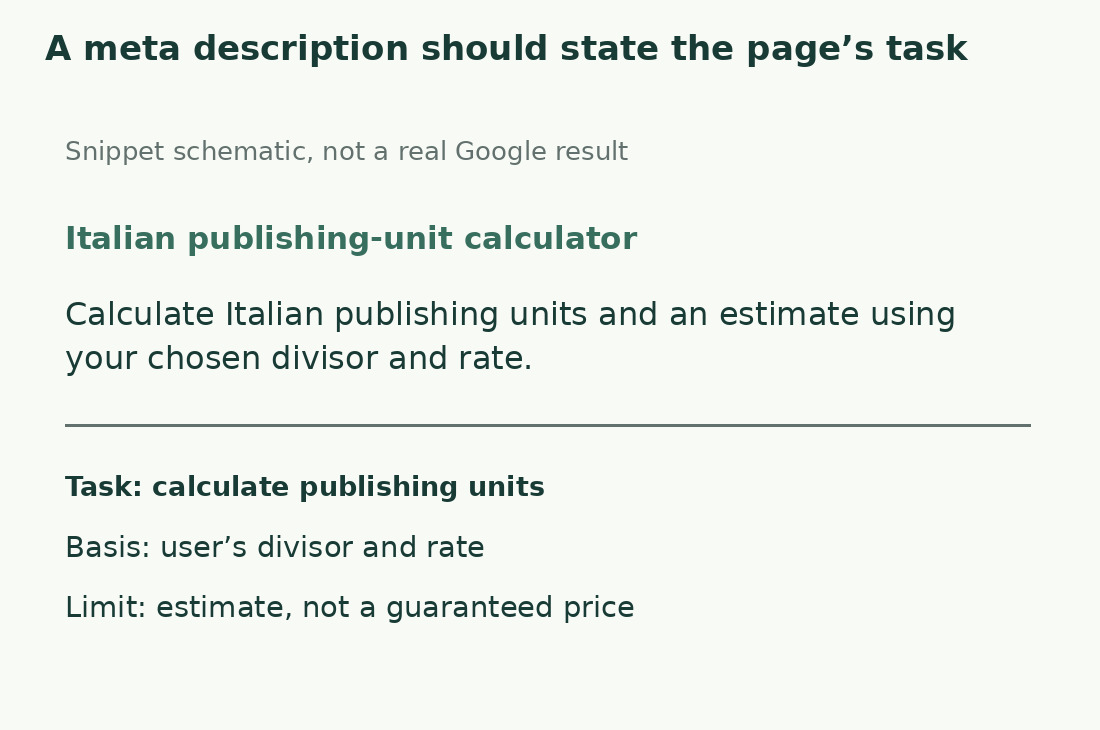
For an Italian publishing-unit calculator, mention selectable unit size, resulting quantity and estimates using the reader’s own rate. For a guide, state the question: why an A4 page and an Italian cartella
differ. Keep important limits. “Convert scanned PDFs” misleads if a tool only reads extractable text. “Calculate the exact translation price” overpromises if quantity × rate excludes minimums, tax and extras.
A meta description is not the snippet
The description is information in page code. A snippet is the summary shown for a particular search. Google says snippets come mainly from page content and may use the description when it represents the page better.
Good metadata does not command exact search-result wording. Different searches can show different passages. Improve an unclear body sentence appearing as a snippet rather than continually changing only metadata. Make visible paragraphs understandable independently: “as stated above” needs context; an explicit subject and result help. Avoid artificial writing designed only for extraction.
Why 160 characters is not magic
Character counts do not capture visual width: narrow and wide letters take different space. Presentation varies with device, query and interface. Google specifies no fixed description length; snippets are shortened as needed.
An internal target can encourage concision, but keep it flexible and identify it as editorial guidance, not a Google technical rule. Put decisive conditions early. “Free” followed much later by a limitation changing the promise can mislead if text is cut. State the result and essential limit first, then less decisive detail.
Three drafts for an imagined page
For a speech-duration guide, “Everything you need to know about reading time, with a useful, current guide for every need” fails to distinguish silent reading from speaking or explain the method.
“Estimate speech duration from word count. Choose a pace, add pauses and check the result with a timed rehearsal” identifies the task. The page must support pause calculations or change its promise. “Have ten minutes to present? Build a word budget and allow for slides, pauses and questions” serves another task. It may suit presentation planning rather than an automatic keyword variant for one arithmetic page.
Reflect real differences between pages
Map tasks before writing many descriptions. If two can differ only by a number or synonym, the pages may not offer distinct results. Merging content can be better than inventing metadata differences.
Keep a consistent catalogue voice while varying useful facts: input, method, output and limits. Avoid the same adjective sequence everywhere. Google recommends relevant, individual descriptions. Start from demonstrable content: word count, publishing units or note-inclusion rules. Specificity comes from the page rather than cosmetic vocabulary variation.
Check code, content and promise
Use the character counter to measure drafts and identify cuts. Then check subject, useful verb and essential limitation. Slightly longer wording can be justified if it prevents a substantial misunderstanding.
Check the actual site for one correct description per page. Templates can assign one summary to all URLs. Sharing metadata should describe the same product. Revise when a feature changes value or limits, rather than simulating freshness through endless rewrites. Record substantive changes and use real search data, where available, to assess alignment with incoming requests.
Make the summary trustworthy
Remove keyword lists without meaningful sentences. Replace unsupported superlatives with actions users can perform. Remove dates inserted merely for clicks. A visual preview cannot guarantee appearance on every device.
Does the visitor find the announced task? If the answer needs many qualifications, correct the promise or page. Counting supports concision; fidelity to content makes the summary dependable.
From generic wording to a checkable promise
| Draft | What is missing | Useful edit |
|---|---|---|
| Complete guide for every need | Task and result | Name the conversion or decision |
| Exact translation price | Estimate limits | Say it uses the entered rate |
| Guaranteed display in 160 characters | Control over snippet appearance | Use a flexible editorial target |
Sources and checks
- Google Search Central: snippet e meta descrizioni · Snippet selection, no fixed description limit and page-specific descriptions.