Understand the two elements
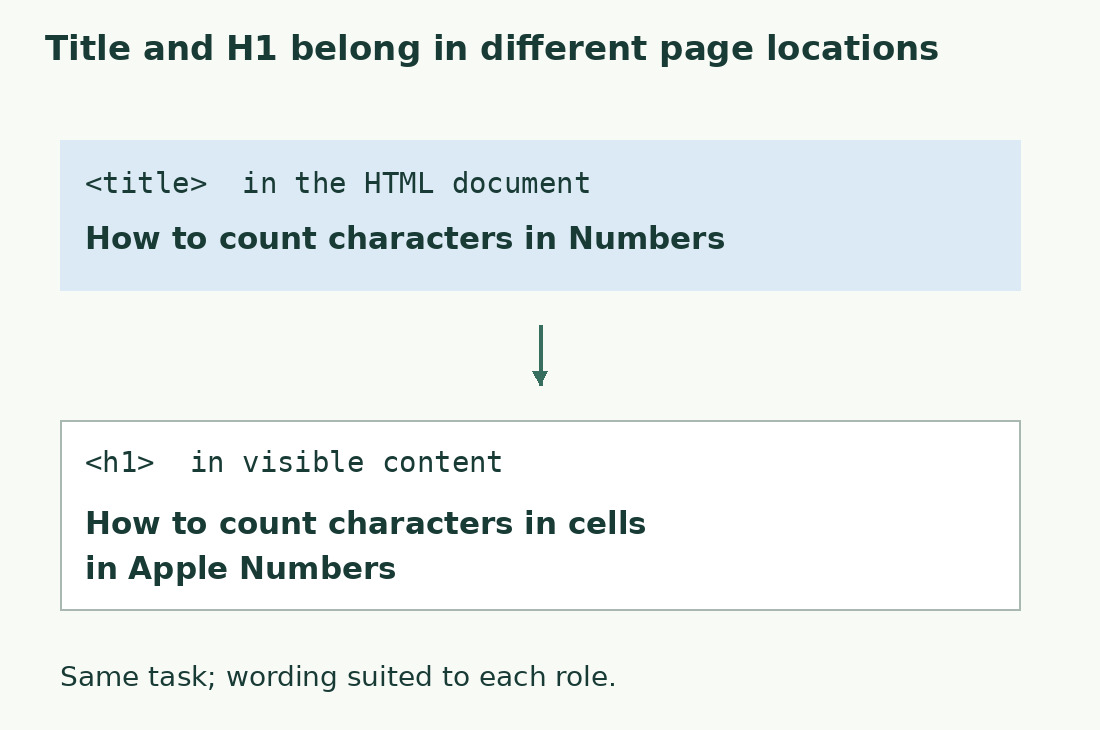
The <title> element is metadata. Its content can appear in a browser tab and contribute to a search-result title. H1 belongs to the page document. Their location and function differ; their words do not have to.
“How to count characters in a text” can suit both. The title may add the site name to distinguish tabs; H1 may clarify a result if that does not become cumbersome. Do not invent differences just to fill CMS fields. A title promising a converter and H1 introducing theory create conflicting expectations. Both should orient readers toward the same experience.
Name the task, not just the topic
“Characters” names a subject. “Count characters with and without spaces” identifies an action and distinction. A slogan such as “Words matter” adds tone but cannot explain the service alone.
Guide headings should express a problem or decision. “Italian publishing units” suggests an overview; “Why publishing units and pages differ” promises a specific comparison. Do not present that comparison as a complete publishing manual. Complete “This page enables someone to…” before choosing wording. If the answer lists unrelated tasks, review the architecture: titles cannot repair confused scope.
Check words raising expectations
“Exact”, “complete”, “official”, “free” and “unlimited” require different checks. A counter can be accurate under declared rules and still differ from an editor including notes or line breaks. It should not promise identical results in every program.
Citing an organisation’s documentation does not make an independent tool its official product. Keep the distinction clear. Include a year when a verified version or change matters, rather than to make an unchanged calculation seem fresh. Stable tasks often need neither a date nor the maintenance it creates.
Match title pairs to goals
A tool could use title “Word count and reading time” and H1 “Online word counter”. The secondary result must exist, and the body should explain dependence on the chosen speed.
A submission guide might pair “Characters including spaces: checks before submission” with “How to check a character limit”, promising criteria and a procedure rather than automatic conversion. “Gulpease for Italian: formula, interpretation and limits” promises more than an input box and score. Check that actual sections justify each promised element, not merely that the string is short.
Count to edit, not chase a maximum
The character counter compares versions and highlights avoidable wording. First cut material that does not distinguish the page, such as a long repeated brand description. Keep the task term and necessary condition.
Google defines no maximum title length in characters. Result titles can adapt to space; a plugin’s suggestion is not a search-engine rule. Visual width depends on more than character count. Read only the opening: can readers recognise the task before potential truncation? Reorganise adjective-heavy starts rather than abbreviating every word.
Inspect published output
A CMS field is not always the final document. A template can add a suffix, a plugin duplicate the site name or a translation retain the wrong language. Inspect generated output.
The main heading should stand out rather than compete with three equal-size slogans. Subheadings need a coherent hierarchy. A hidden H1 with keywords different from the visible title does not improve clarity. Google uses multiple title sources. If its choice differs, check alignment among metadata, H1, content and links before endlessly rewriting the title without addressing the page.
Keep the catalogue distinguishable
Near-identical guide titles make selection harder. If five start “Complete guide”, remove the formula and lead with the specific problem. Readers should choose without opening every page.
After substantial changes, check incoming links. Labels promising the old task create wrong expectations. Consistency between title, links and content requires continuing editorial work.
Check each language functionally
The title and heading must describe the version actually opened. A translated page retaining another-language template title weakens orientation. Preserve the task using the audience’s natural wording rather than mechanically translating promotional phrases. Italian conta battute
, for example, needs the convention about including spaces explained in English. This is a language and function check, not an excuse to add title synonyms.
Coherent pairs without artificial differences
| Page | Possible title | Possible H1 |
|---|---|---|
| Word tool | Word count and reading time | Online word counter |
| Submission guide | Characters including spaces: submission checks | How to check a character limit |
| Italian Gulpease guide | Gulpease: formula, interpretation and limits | How to interpret Italian Gulpease scores |
Sources and checks
- Google Search Central: link dei titoli · Descriptive, concise, consistent titles; no fixed character maximum and multiple result-title sources.