Find the applicable requirement
Consult the course’s final-assessment page, regulations or supervisor’s template. Search “abstract” and local summary terms. Check degree type and academic year, distinguishing upload instructions from text inside the thesis.
The consulted University of Genoa DIEC guide suggests roughly 150–200 words for Italian and English abstracts in that context, not every thesis. Follow your actual requirement and clarify ambiguity. Record source and consultation date. “Maximum 200 words per version, excluding title” is valid only if those conditions are stated or confirmed. Do not turn “brief abstract” into an official numeric cap.
Words and characters need different checks
Some academic destinations count words; others count characters including spaces. The university journal Argomenti requests Italian and English abstracts of about 700 characters each including spaces. This illustrates an editorial unit, not a thesis rule.
Do not convert character caps into fixed words: vocabulary length, spaces and punctuation vary. Use the word counter for words and character counter for characters. Establish whether title, keywords and references have separate fields. Count the assessed selection. If the portal differs, identify its inclusions before resorting to artificial abbreviations or assuming another convention.
Build from completed work
Write separate lines for question, material, method, main result and decisive limit. This avoids motivation taking the space while results remain vague. Empirical and theoretical work need not use identical proportions.
For theory, identify positions compared and the clarification achieved; do not invent samples or numbers to imitate experiments. For empirical work, include what makes the conclusion intelligible without a complete methods section. An early draft can guide the project, but final wording must reflect completed work. Remove planned analyses not performed and update every language after conclusion changes.
An original bounded-result example
Imagine a fictional thesis comparing booking requests received by two counters in one month. “The thesis addresses highly topical digitalisation and proves online services improve everyone’s experience” makes claims those data cannot support.
The study compares request completeness at two counters during the observed month. It distinguishes submission channel and presence of required attachments. Within the described sample, form-submitted requests are more often complete. The comparison does not measure satisfaction or attribute the difference solely to the channel.
This illustrative passage is neither a full abstract nor real research. It shows a bounded question, analytical criterion, finding and interpretation limit. Add details only when the actual study documents them and they explain the contribution.
Cut without losing interpretive essentials
Remove chapter announcements before results. “Chapter one illustrates…” describes a contents list, not necessarily what the work adds. Replace chapter sequences with the question and necessary reasoning.
“Innovative”, “fundamental” and “in-depth” consume space without specifying contributions. Concrete material and comparison are more informative. Do not make every technical term an unexplained acronym. When removing figures, ask which interpretation changes. Sample size may establish scope while a second percentage is redundant. Keep evidence preventing conclusions broader than justified.
Check languages separately
Translations vary in length. Count each version separately if the requirement does, rather than combining languages. Do not shorten one by deleting a caveat retained in the other.
Use a parallel matrix for question, method, result and limit. Check units, values, negation and comparison direction; these matter more than modest length differences. Verify disciplinary equivalents. Attribute linguistic review only when performed, recording checks and unresolved questions if useful. Correct counting does not establish translation quality or supervisor approval.
Check the actual submission
Compare abstract, final title and conclusions: they should describe the same work and result status. Reread after pasting into the field, where truncation or unexpected additions can occur.
Follow separate keyword-field requirements rather than adding terms to the body for presumed visibility. Preserve a faithful, self-contained account for new readers. Save the submitted version with the applied requirement. If the supervisor changes title or conclusion later, determine whether the portal abstract needs updating. Length, unit, scope, language consistency and agreement with the thesis all require final checks.
Decisions to record before counting
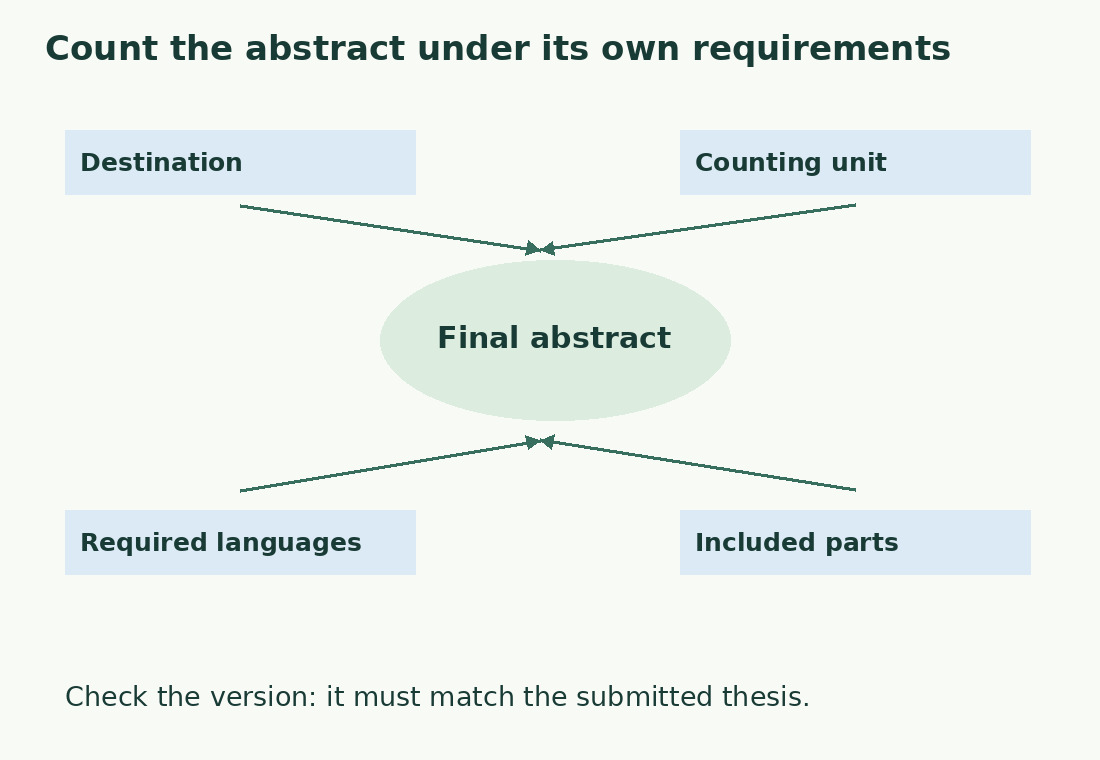
| Item | Question | Mistake prevented |
|---|---|---|
| Destination | Course, repository or journal? | Using another context’s rule |
| Unit | Words or characters with spaces? | Arbitrary conversion |
| Languages | Separate limit per version? | Combining separate texts |
| Scope | Title and keywords included? | Wrong selection |
| Version | Matches final thesis? | Outdated project |
Sources and checks
- Università di Genova, DIEC: guida alla tesi magistrale · Local indicative 150–200-word guidance with Italian/English versions.
- Argomenti, Università di Urbino: norme per gli autori · Journal example of about 700 characters including spaces, distinct from thesis requirements.