Turn the assignment into checkable criteria
“Within 150 words” sets a cap; “about 150” may allow flexibility if intended by the recipient. No universal tolerance percentage applies. Draft conservatively and clarify ambiguous instructions.
Check whether summarising a passage, chapter or position, and whether a title, comment or citation is required. Separate personal commentary where requested, so readers can identify source claims. Mondadori Education’s consulted material illustrates reformulation at different lengths, not a required original-to-summary ratio. Assignment defines scope; actual content determines selection.
Map facts and relationships
Write a provisional core sentence before applying the limit. List what prevents misunderstanding. Narratives may need event, decision and consequence; arguments need thesis, reasons and a decisive objection.
Do not assign equal space per original paragraph. An introduction may repeat the title while a short final sentence qualifies everything. Mark cause, contrast, condition, sequence and example. “Opening hours increased, but loans fell” differs from two disconnected figures. A relationship map supports compression without losing reasoning.
An original passage to shorten
For six weeks, the neighbourhood library stayed open until nine on Wednesdays. The trial tested whether evening hours helped people working during the day. Thirty people visited in the final two hours; twelve had not visited in the previous month. Staff also received nine requests for evening opening on another day. However, the service required two additional staff members. The library has not decided whether to continue: it will first compare costs with other ways of extending hours. The data do not show whether new visitors will become regular users.
The passage and numbers are fictional. Its core is not “evening opening succeeded”: no criterion establishes that overall judgement. It reports a bounded trial, visits, staffing resources and an unresolved decision.
Retain what is unknown
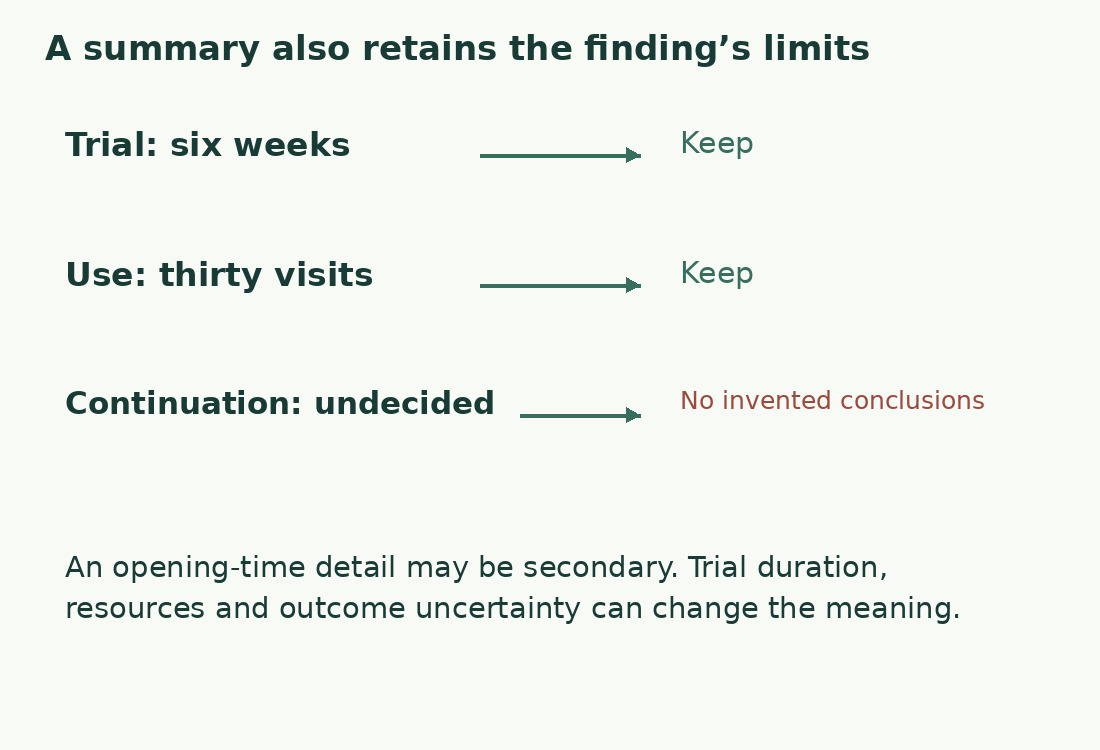
The library trialled evening opening for six weeks, recording thirty visits in the final two hours. The extension required two additional staff. Before deciding whether to continue, it will compare costs with other options. Whether new visitors become regular users is not yet known.
This removes weekday, closing time, nine requests and the twelve-new-visitors detail. It keeps trial duration, main observation, resources and the open decision. It suits a task asking for outcomes; neighbourhood requests could justify another selection. “Evening opening attracted new users and will continue” invents a decision. Check every claim against the source, especially “proves”, “resolves”, “confirms” and “causes”. Plausibility does not establish fidelity.
Reduce meaning units
Combine compatible information: “The trial lasted six weeks” and “The library opened in the evening” become “The library trialled evening opening for six weeks”. Do not combine different periods or groups.
Generalise only where details do not change the point. “More resources” may replace “two additional staff” under a tight cap but makes costs less concrete. “Always” cannot replace “during the observed period”: it broadens the claim. Check pronouns after deleting antecedents. Repeating a key noun can be clearer than an elegant synonym; fidelity and clarity outweigh variety.
Count the version to be submitted
Use the word counter once content stabilises. Exclude original and notes; include title or other required elements. Save the measured selection if editing continues elsewhere.
If over the cap, remove secondary detail or repetition before “but”, “because” or “only if”, which may carry essential logic. Do not evade limits through invented abbreviations, unnecessary hyphens or missing spaces. Tool conventions differ and clarity suffers anyway. Compare disputed cases with the destination count and leave reasonable margin without sacrificing necessary conditions.
Review in both directions
Read the summary alone: are subjects, problem and outcome clear? Then find source support for every sentence. The first pass finds gaps; the second finds additions and distortions. Fluent text can still be unfaithful.
Check numbers, negations and certainty. “May”, “must” and “will” are different; changing “some” to “the” can generalise a limited observation. Reconsider selection if more cuts are needed instead of weakening boundaries. Finally reread the assignment. A faithful summary can answer the wrong question. Counting checks the cap; semantic review checks the right core remains.
Changes between passage and summary
| Information | Decision | Reason |
|---|---|---|
| Six-week trial | Keep | Bounds observation |
| Wednesday until nine | Omit | Secondary for this task |
| Thirty visits and two staff | Keep | Shows use and resources |
| Continuation undecided | Keep | Avoids an invented decision |
| Regular future use unknown | Keep | Retains the finding’s limit |
Sources and checks
- Mondadori Education: Il riassunto, webinar didattico del 2018 · Teaching examples of reformulation at different lengths, not a universal summary ratio.