Find your programme’s instruction
General searches mix bachelor’s, master’s and doctoral guidance. Requirements can differ even within one university. Check programme, assessment type, document version and intended students.
Keep the official page and applicable document. An older guide may remain the designated reference; verify instead of assuming validity or obsolescence. If uncertain, call its figure a reference to confirm rather than a current requirement. An advice site cannot settle the administrative issue. Discuss research scope with the supervisor: a focused question and broad literature review need different development. Length becomes useful when tied to goal, materials and method, rather than resemblance to another thesis.
Separate cap, guidance and agreement
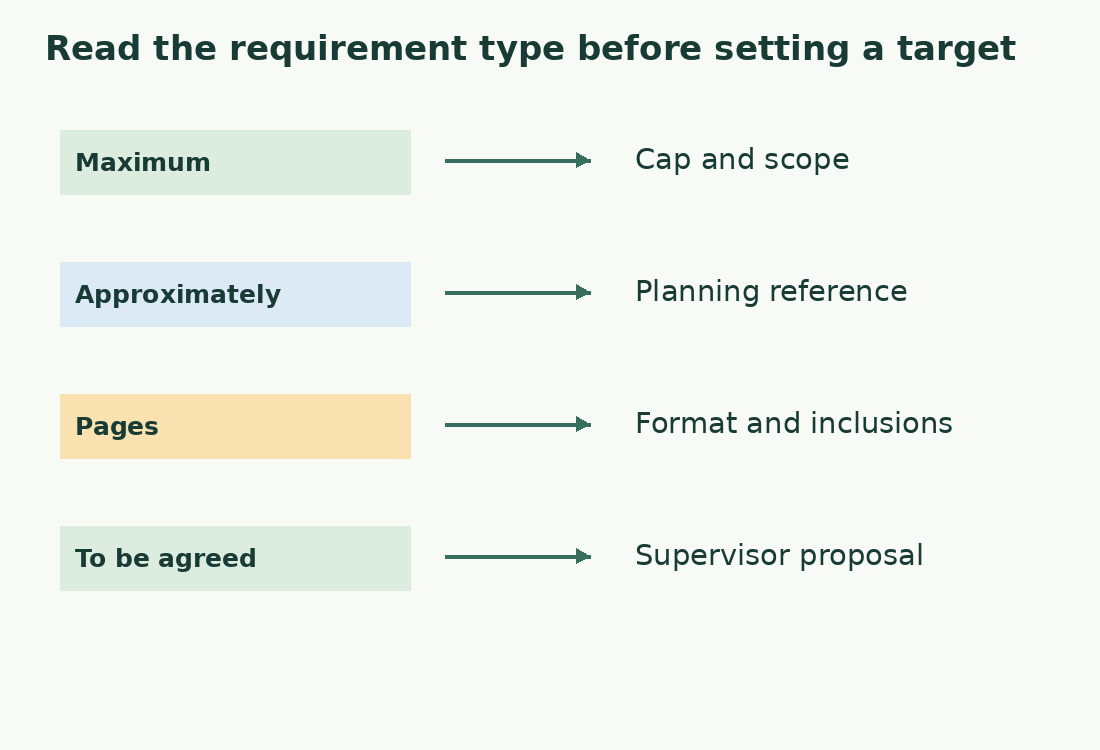
“Must not exceed” sets a cap; “approximately” gives guidance. Preserve that difference in planning and final checks.
The consulted University of Milan MASS manual for 2021–22 lists 50–70 pages and around 20,000–30,000 words as initial reference dimensions. These apply to that document and programme, not a universal page conversion or current requirement elsewhere. The University of Genoa DIEC guide points to agreement with the supervisor about structure. If relevant instructions conflict, keep both and ask which applies instead of silently choosing the easier one.
Define the counting scope
A page requirement may include or exclude title page, contents, appendices and bibliography. Words may refer to body or whole document. A precise-looking result cannot resolve undefined boundaries.
List every component as included, excluded or unresolved. Do not assume notes are always excluded or tables do not count. The applicable submission convention governs. Use the word counter for consistent drafting selections, separating monitoring from any prescribed formal method. If extracting a complex document, check no required material is lost. This guide addresses scope decisions rather than promising automatic import of all formats.
Plan from questions, materials and results
For every chapter, state its question, materials and required intermediate result. This is more useful than distributing equal words among headings.
An internally agreed hypothetical 24,000-word plan could allocate 2,000 to introduction, 6,000 to theory, 4,000 to method, 8,000 to analysis and 4,000 to discussion and conclusion. The sum is 24,000; distribution remains provisional until materials are known. Explain a decisive method choice adequately rather than preserve attractive proportions. Merge duplicated literature reviews where appropriate while keeping every part’s contribution visible.
If short, identify the substantive gap
A short draft may omit source-selection criteria, method justification, an alternative comparison or limitations. Reconstruct evidence to conclusion and identify what is missing, rather than only how many words.
A general history can increase length while leaving data choices unexplained. Quotations do not substitute for comparison, argument and correct attribution. Ask “The sample choice is described but not compared with an alternative; should that be developed here?” rather than simply “I need three thousand more words”. The first enables a content decision.
If long, protect the reasoning
Find duplication across introduction, chapters and conclusion. Retain useful reminders, reduce near-identical passages. Introduction poses the question, analysis supports the answer and conclusion explains meaning and limits.
Follow actual appendix rules. Moving supporting material can help readability, but cannot evade a cap including appendices or remove the only necessary explanation of a result. Cut irrelevant passages and rewrite overloaded ones. Examples and cautions may make conclusions verifiable; do not discard them merely as apparent extras. After major cuts, check references, numbering and concepts introduced in deleted parts.
Record the final bounded check
Before submission, record source, document version, unit and scope; use the specified counting method if any. An earlier count cannot confirm a final version after heading, note or section edits.
Check separately limited fields such as abstracts independently rather than automatically copying the body’s convention. This record does not certify academic merit. It documents which instruction was applied and how. State unresolved conditions and seek focused clarification before submission. The goal is a complete argument in a submission matching your programme.
Before adopting a numerical target
| Wording | Meaning to check | Action |
|---|---|---|
| Maximum | Cap and included parts | Check the final required selection |
| Approximately | Planning reference | Compare with materials and method |
| Pages | Format and inclusions | Avoid universal word conversions |
| To be agreed | Project decision | Bring a reasoned supervisor proposal |
Sources and checks
- Università degli Studi di Milano: manuale MASS 2021-22 · Dated local example: 50–70 pages and around 20,000–30,000 words in the 2021–22 manual.
- Università di Genova, DIEC: guida alla tesi magistrale · Agreement with the supervisor about structure, not a national standard.