Use actual instructions
Before creating slides, state what listeners should know or decide afterward. Seeking approval, defending a thesis and teaching a procedure require different routes. Time constrains the route but does not choose the goal.
The consulted University of Milan MASS manual for 2021–22 allowed about fifteen minutes for a thesis presentation, followed by questions. This is a dated local example separating talk and discussion, not a rule for all degrees or confirmation of current requirements. Record your duration, question arrangements, allowed materials and audience. Resolve uncertainties before allocating minutes. Material for experts may need substantial revision for people requiring basic definitions.
Allocate time to reasoning, not slides
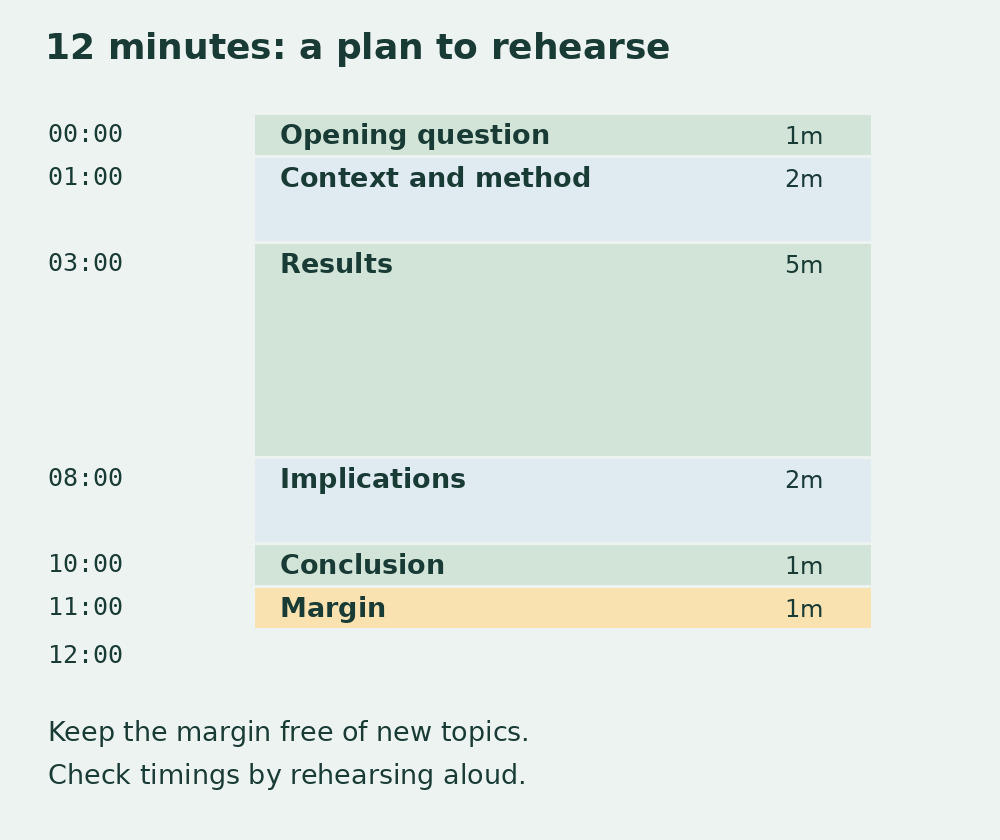
For a hypothetical twelve-minute talk with questions outside the slot, reserve one minute for the opening question, two for context and method, five for results, two for implications, one for conclusion and one as margin. This is a testable plan, not an ideal formula.
A question slide can take twenty seconds, a multi-comparison graph several minutes. Equal timing per slide can squeeze the central result and stretch easy material. Note what each block must change in understanding. If two slides support one claim, consider keeping one for questions. Backup material should not enter the main route merely because it took effort to prepare.
Allow time to understand visuals
For three columns showing requests received, complete requests and accepted requests, first explain categories, then the important comparison, then the limitation. Reading every value need not explain relationships.
“The middle column excludes applications missing attachments, so it differs from the total received” prevents misunderstanding; “Here is a very interesting chart” does not help. During rehearsal, actually look at the visual. If you search for its legend, listeners probably need time too. Clarify figure or narration before speaking faster. Splitting the comparison into two stages with an explicit question-to-result transition may work better.
Find overruns with checkpoints
Note elapsed time after each block rather than every sentence. Three or four checkpoints show whether delay accumulates in context, results or conclusion; total duration alone cannot locate it.
If context and method end at minute five instead of three, do not cut the conclusion immediately. Investigate a necessary new definition, repetition or digression; each calls for a different response. Save timing with the draft. Old timing does not verify a revised version. Recheck a minor phrase locally, but run the complete route after moving results or removing blocks to verify connections too.
Rehearse the format you will deliver
A full script exposes unnecessary words and missing transitions; notes support structured speaking. Planning with a script and delivering from notes can work, provided the actual presentation format is rehearsed.
“Main result” is too vague if three findings are similar. A useful cue includes claim, key evidence and limit: “fewer errors in complete applications; same-period comparison; no conclusion on waiting times”. It protects essential information without prescribing every word. The script word count detects growth after edits, not improvisation. If notes produce a longer rehearsal, use that observed time and identify added material.
Plan cuts in advance
Give each block a function and priority. Keep the answer to the opening question in the core; a third example may be optional. Mark a direct path from the preceding block to a complete conclusion. A short version should not apologise or refer to skipped material.
Prepare the final sentence. If interrupted, use remaining seconds for the contribution and next decision, not a list of unshown slides. Margin need not be filled; it absorbs clarification, slow slide changes or necessary pauses. Consistently generous margin can justify extra depth. Variable timing favours a simpler core.
Check real materials and understanding
Where possible, rehearse with the intended screen or device. Check readability and file order. Mental reading without material changes or observation time is not a complete rehearsal.
Ask an observer to reconstruct question, result and limitation, not just rate the slides. Record actual observations without claiming general content or accessibility validation. Give final files recognisable names and keep essential materials. Use checkpoints during the event; apply prepared cuts and finish the reasoning promised at the beginning.
One possible twelve-minute allocation
| Stage | Planned time | Check |
|---|---|---|
| Opening question | 1 minute | The audience knows the problem |
| Context and method | 2 minutes | The comparison basis is clear |
| Results | 5 minutes | Every value answers the question |
| Implications | 2 minutes | Limits and decisions are explicit |
| Conclusion | 1 minute | A complete answer remains |
| Margin | 1 minute | Not assigned to new topics |
Sources and checks
- Università degli Studi di Milano: manuale MASS 2021-22 · Dated local example: about fifteen minutes for a thesis talk followed by questions, in the 2021–22 manual.