Define the allowance
“Ten minutes” can mean ten minutes speaking or a complete slot including introduction and questions. Clarify with the organiser. A one-minute moderator introduction and two-minute discussion reduce the script allowance.
Record total duration, included components, timer start and closing signal. Use course instructions for assessments or the actual meeting agenda, not another event’s template. Opening and conclusion belong inside the allowance. Pointing at a graph and letting listeners locate a value also take seconds. Do not add a “tiny” conclusion after occupying all available time.
Measure representative delivery
Deliver a sample as in public without racing the timer. Include a technical definition, transition and number when present in the talk. An easy greeting at home does not represent complex explanation before a panel.
Divide spoken words by minutes. A hypothetical 260 words in two minutes yields an overall 130 words per minute, already including its pauses. Do not subtract them again. Alternatively measure voice-only speed and add pauses separately. Either model works when labelled “overall rehearsal pace” or “voice-only pace”; do not mix them.
Calculate the word budget
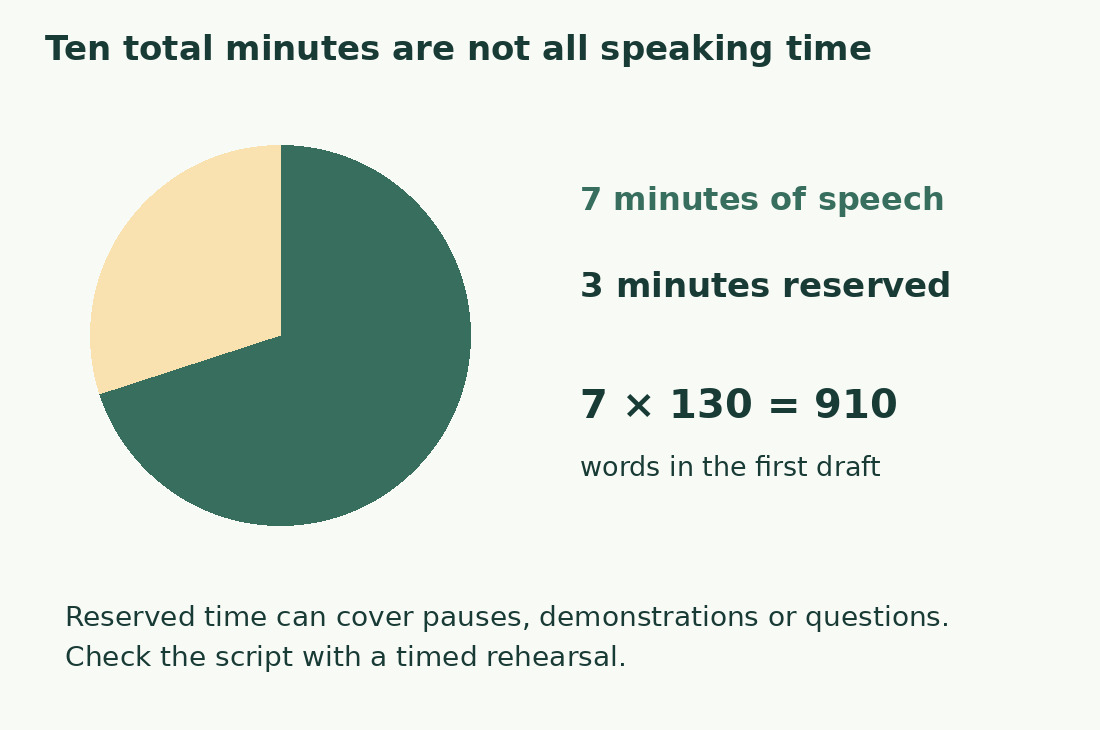
Ten minutes including two for questions and one for a silent demonstration leave seven. At assumed overall 130 words per minute, 7 × 130 = 910 words. This describes one plan, not a language-wide standard.
Five uninterrupted minutes at that rate yield 650 words; thirty yield 3,900. Long talks need not be continuous readings: reserve interaction, exercise and material-change time first. Thirty minutes with six reserved gives 3,120 words. Use the word counter on spoken text only, excluding “change slide” and “wait for answer” notes or making a separate copy.
Written tokens differ from spoken words
Codes, percentages and dates can look short but require longer explanations. “2026” has context-dependent readings; acronyms can be spoken or spelled out. The counter does not know the speaker’s choice.
Temporarily expand sensitive numbers into the wording you will say, such as the spoken form of “3.5% of cases”, and rehearse. A full phonetic transcription is unnecessary. Focus on figures, references and unfamiliar names. Mark significant gestures too: “As the right-hand column shows” requires audience search time before the next point. Leave space for the behaviour you expect.
Cut a block before speeding up
Separate an essential question, result and significance from removable depth, such as a second example or extended methods. Plan cuts before a sudden time reduction threatens the conclusion.
Instead of “Before going into the detail of our results, I would like to spend a few moments briefly recalling why we addressed this issue”, state the project’s question. This brings useful orientation forward. Keep necessary caveats such as “The sample does not represent the whole population”. Cut ceremonial background or duplicate examples before broadening a limited finding.
Rehearse the whole route
Time from opening through final sentence with real materials. Change slides and handle objects if those actions belong. Script-only reading misses them. Save each rehearsal’s script version.
Repeat difficult segments without seeking a record. A short run may skip an explanation: check essential content and intelligibility. If duration varies widely, allow margin or simplify instead of promising second-level accuracy. Research distinguishes oral and silent reading; do not transfer one estimate to the other. Use a relevant sample and complete rehearsal to determine what stays or moves to supporting material.
Prepare a complete short version
Choose an exit before the event. After the main result, skip a marked optional block and move to a coherent conclusion. Avoid random cuts with one minute left.
Preserve dependencies. If an indicator’s definition disappears, do not assume it in the conclusion. Remove “both examples show” if the second case is cut. Rehearse the reduced route from start to finish and measure it separately. Fewer words alone do not prove it works for someone hearing the argument once.
Initial drafts at an assumed 130 words per minute
| Total time | Reserved time | Hypothetical budget |
|---|---|---|
| 5 minutes | 0 minutes | 650 words |
| 10 minutes | 3 minutes | 910 words |
| 30 minutes | 6 minutes | 3,120 words |
Sources and checks
- Brysbaert, 2019: revisione delle velocità di lettura · Distinction between silent and oral reading; no universal speaking rate for a specific language or context.