Start with tracks, not document totals
A script can include dialogue, narration, camera directions, cards and editing notes. Counting everything does not measure speech. Classify lines as voice, image, sound or internal annotation.
“Open Bookings” can be spoken while that step appears; “shot of the menu” is visual direction. Count a spoken-only copy, retaining production instructions in the main document. Separate speakers too: a narrator’s pace does not automatically represent dialogue with hesitation and reactions. Define whether estimating a read script, guided conversation or interview selected later in editing.
A ninety-second budget
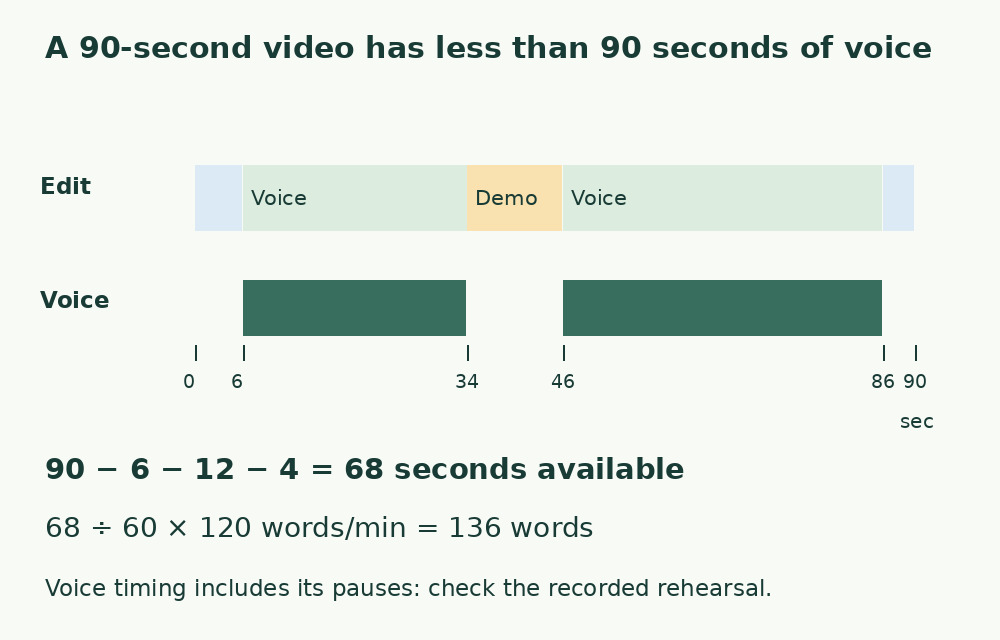
A hypothetical ninety-second video reserves six seconds for a silent title, twelve for a silent demonstration and four for closing imagery. These consecutive non-speaking elements total twenty-two seconds, leaving sixty-eight for narration and pauses included in its rehearsal pace.
At an assumed overall 120 words per minute, 68 ÷ 60 × 120 = 136 words. This is a scenario, not an ideal video rate for a language. Replace it after recording a sample in the intended tone. Paste only voice text into the word counter. A 220-word result needs significant revision: reduce content, agree a longer duration or redistribute scenes. Two small cuts or hurried delivery may not preserve the explanation.
Add consecutive, not overlapping time
A screen visible for ten seconds with eight seconds of simultaneous narration can form a ten-second scene, not eighteen. If the explanation follows the screen instead, the times add.
Record start and end with columns for “from”, “to”, “image” and “voice”. This reveals duplicated intervals before opening an editor; compare it to the real project later. A sixty-second recording containing breaths and pauses already includes them. Do not add another generic pause allowance. Add only absent freeze-frames or waits and keep the chosen method explicit.
Rewrite for listening
Speak names, figures and acronyms as intended. Three percentages may look brief yet be hard to follow. Where exact values are unnecessary, show them and explain the relationship; where needed, give time to connect figures and meaning.
Compare “Within the functionality made available by the platform, the possibility exists of consulting reservations previously made” with “Open Bookings to see your appointments”. The latter offers an action and result, but only if “Bookings” is the visible label. Retain essential conditions: if sign-in is required, explain it before viewers search. A short video needs a selected task, not instructions valid only for an unstated case.
Measure synthetic audio after generation
W3C SSML 1.1 describes synthesis controls including pauses in seconds or milliseconds and rate adjustments. A standard does not guarantee every service supports them identically. Check the actual system’s documentation before using markup.
Plan from exported audio with final voice, language and settings. A speed percentage is not a universal words-per-minute rate. Voice changes can alter timing and pronunciation of numbers, names and abbreviations. Regenerate and listen after changes. Keep text and settings with audio versions. Compare identical scripts or document edits, so text cuts are not mistaken for voice effects. Shorter output alone does not prove a better explanation.
Allow viewers to look
Narration can end before viewers locate a control. Plan recognition time; highlighting reduces searching but cannot replace a correct sequence. Avoid changing screens while still explaining the previous one.
Check cards and subtitles in the destination format. This guide sets no universal subtitle reading threshold: size, segmentation and distribution rules need separate checks. A scene must support its assigned task. Decide whether a closing summary must be read or merely recognised. Three seconds cannot make a dense list usable. Reduce it to a next action and offer details in accompanying material only if that resource exists.
Verify before final delivery
Record a read-through and make a rough edit with needed visuals. It need not have final effects; it must show whether speech and imagery support each other within time. Note missing images, sentences running beyond scenes and purposeless silences.
Associate edits with observed problems: bring a phrase forward, lengthen a scene for a detail, remove duplicate statements or consider a separate video for an independently useful demonstration. Measure the exported file including title, tail and silences. Script duration is a planning estimate; final file duration is the production result. Retaining both explains differences for future revisions.
Original ninety-second budget
| Consecutive part | Duration | Treatment |
|---|---|---|
| Silent title | 6 seconds | Subtract from speech allowance |
| Silent demonstration | 12 seconds | Subtract from speech allowance |
| Silent closing | 4 seconds | Subtract from speech allowance |
| Voice and its pauses | 68 seconds | 136 words at assumed 120/minute |
Sources and checks
- W3C: Speech Synthesis Markup Language 1.1 · SSML break/prosody elements, second/millisecond pauses and voice-dependent default rate.