Define the task
“Six minutes to read” is useful with a defined scope. It may describe continuous article-body reading rather than source checking, exercises or table comparisons. Exam preparation needs another estimate from deciding whether to open a news item during a break.
A beginning-to-end estimate can suit an explanatory article; operational material may be consulted through jumps between sections. A total does not describe every route. Do not substitute aloud-reading speed for silent reading or call words ÷ speed “time needed to understand”. Prior knowledge, conceptual difficulty and questions also affect understanding.
The formula and decimal minutes
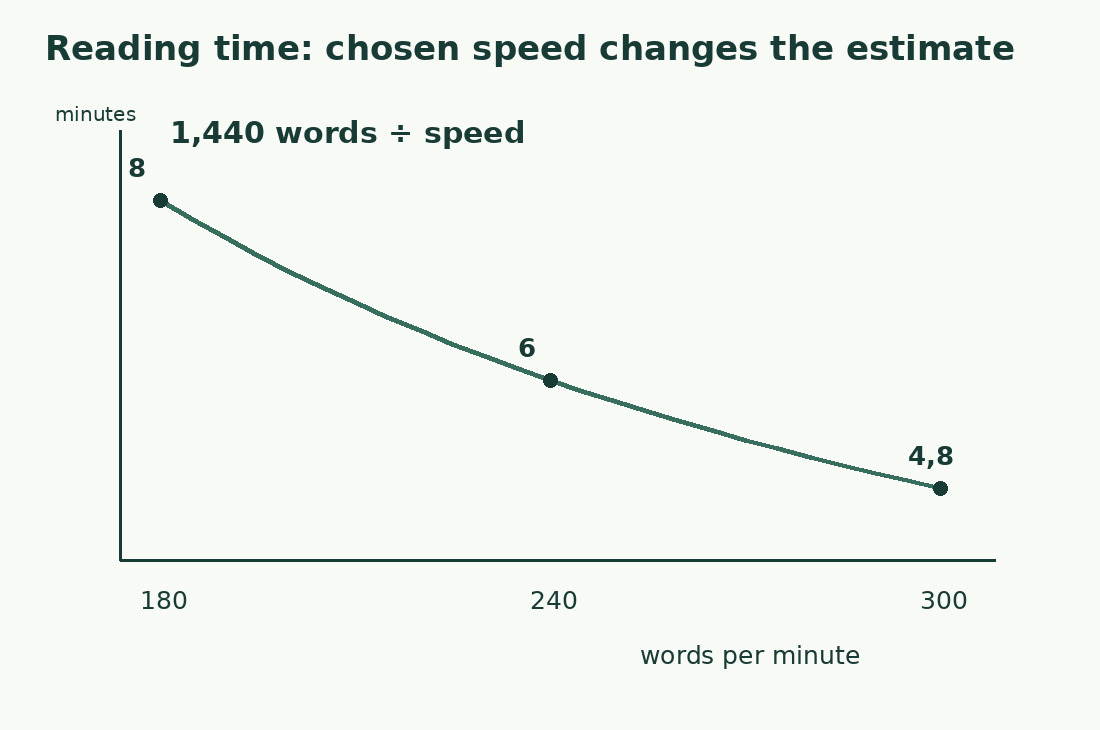
Use minutes = words / words per minute. A hypothetical 1,440-word article at an assumed 240 words per minute gives 6 minutes; at 180, 8 minutes. These scenarios show sensitivity, not an average valid for every language or reader.
1,300 ÷ 200 = 6.5 minutes means six minutes thirty seconds, not six minutes five. Multiply the decimal part by sixty. Use the word counter on exactly the included selection. Round consistently: “about seven minutes” communicates an estimate better than second-level detail when speed is only assumed. Exact arithmetic does not make the model exact.
Calibrate personally
Choose a passage matching language, difficulty and technical content. Read in realistic conditions. Include normal annotations when estimating study; if measuring continuous reading alone, stop before notes and record that boundary.
A hypothetical 720 words in four minutes gives 180 words per minute. Repeat with two more samples, keeping all results and conditions rather than only the best time. One easy text or tiring day should not define every forecast. Summarise the main idea afterward and retrieve an important fact. Moving your eyes without understanding does not measure the intended task. This is planning feedback, not a clinical test or general ability assessment.
Keep research in context
Marc Brysbaert’s 2019 review estimates 238 words per minute for adults silently reading English nonfiction. Its population and conditions matter. It does not prescribe a pace for studying, Italian text or individual readers.
Label values “initial assumption” or “observed sample speed”, rather than calling both “actual speed”, even if close. Research helps frame assumptions and resist spectacular speed claims. When publishing reading time, disclose included words, speed and rounding. Readers can understand differences from experience. The estimate should guide decisions rather than judge people taking longer.
Measure non-prose work separately
An eight-row table may contain few words but need several comparisons; a short formula can require a proof. Plain-text estimates may understate work. Do not apply a universal multiplier; measure the activity separately.
A 900-word procedure plus three checks in another system can distinguish reading and checking time. Do not invent totals when external conditions make checks unpredictable. Explain measurable and case-dependent parts. Optional linked reading may be excluded; a source required for an exercise needs its own allowance. Adding every linked word to the body cannot reconstruct task duration automatically.
Keep an updateable record
Record title, included words, activity, speed, rounded result and non-text elements. After real reading, note the difference and plausible causes: unfamiliar terms, interruptions, data comparison or poor sample fit.
Do not fill every study interval with theoretical continuous reading. Allocate revision and recall explicitly. Recalibrate when purpose changes: returning to find a date differs from first understanding. Use estimates to organise and adjust with experience rather than chase an abstract speed.
Compare consistently
Use the same scope across chapters. Counting captions and notes in one but only body text in another can explain discrepancies. Save samples and exclusions so comparisons survive document revisions.
Separate interruptions too. A telephone call matters for planning the afternoon but does not measure chapter demands. Record elapsed time and task time independently. Both are useful; silently substituting one can falsely imply changed reading speed.
One text, three assumptions
| Words | Assumed speed | Estimate |
|---|---|---|
| 1,440 | 180 words/minute | 8 minutes |
| 1,440 | 240 words/minute | 6 minutes |
| 1,440 | 300 words/minute | 4 minutes 48 seconds |
Sources and checks
- Brysbaert, 2019: revisione delle velocità di lettura · Average adult English nonfiction silent-reading rate and its population; not a universal rate.