Define the response needed
Complete “After reading, the recipient should…” before drafting. They might confirm a date, choose an option or clarify a requirement. Without an intended action, you risk sending a story from which they must infer the question.
“I would like submission information” is too broad when only bibliography inclusion is unclear. Ask directly and identify the consulted page. Precision exposes the unresolved point and reduces follow-up. Combine requests belonging to one task, such as two confirmations for one meeting. Administrative and scientific matters may need different recipients. Split when it improves assignment, not under a rule forcing several messages for one decision.
Use a task-specific subject
“Report submission: confirm attachment by Friday” is more informative than “Urgent” if the deadline is real and that is the required action. Do not invent urgency.
The consulted University of Padua formal-communication guide separates subject, opening, body, closing, signature and attachments, highlighting a concise specific subject. Local conventions remain local rather than universal language rules. Keep reply subjects meaningful. A complete topic change can justify a new one; sending an already requested document should retain useful thread context instead of creating unnecessary reconstruction.
A long message hiding its request
Dear Professor, after checking the instructions again and comparing the file with last week’s version, I realised there are two possible tables. Initially I planned to keep the first, but the second identifies the period more precisely. I am unsure whether to change the introduction we already worked on. I am attaching the document, hoping it is the correct one. Please let me know what you think. Thank you.
This invented email has a real choice but vague final request. Which version is attached, where are the differences and what feedback is needed? The recipient must open the file and reconstruct the problem.
A revision keeping useful context
Subject: Report — observation-period table choice
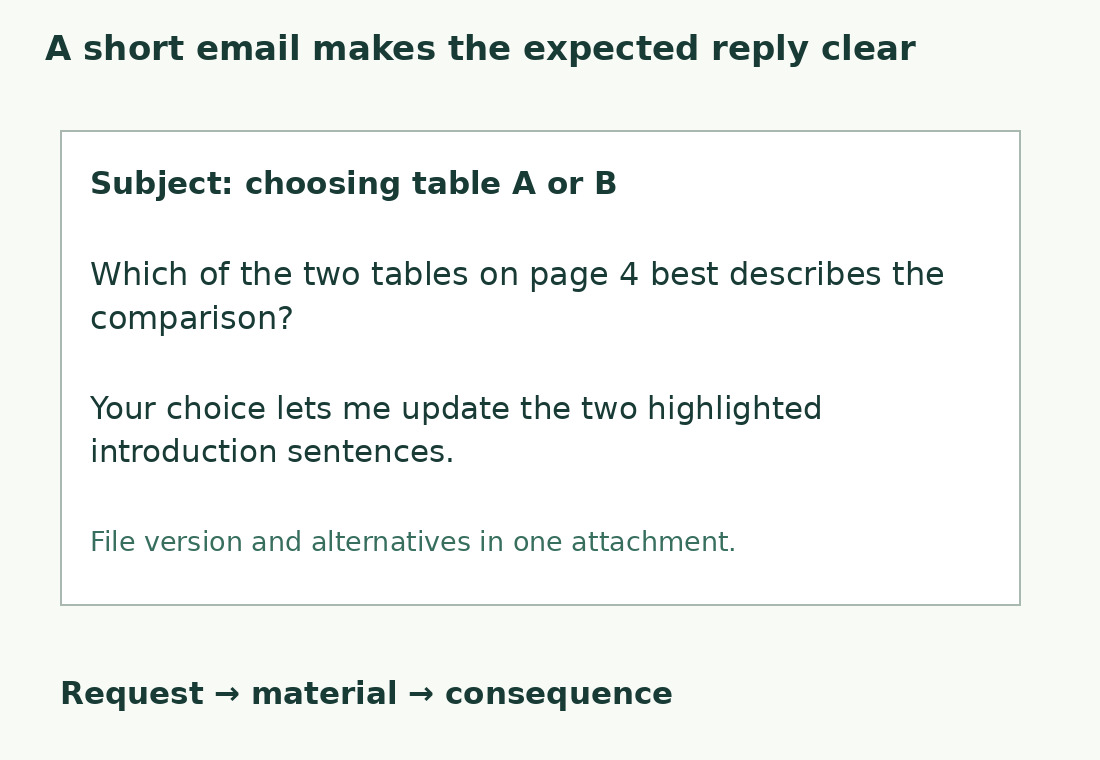
Dear Professor, could you advise which table to use in the report? Both alternatives are on page 4 of the attached file. The second distinguishes observation periods; the first gives one total. If we choose the second, I would update the two highlighted introduction sentences. I have attached one document containing both alternatives. Thank you for your feedback. Name and course.
The edit states the decision, locates evidence and explains the consequence without claiming one table is always better. Adapt to preferences already agreed. Verify page, highlighting and attachment in the real message: a wrong reference creates work even in clear prose. Add a deadline only when real, explaining when and why an answer is needed.
Keep details preventing return questions
The recipient may handle many courses, projects or cases. Use the course, request number or meeting date identifying yours. A code and sentence may replace the full history.
Say what attachments contain and where to look. “Everything is in the file” is unhelpful for forty pages; “Alternatives are on page 4; proposed changes are highlighted” reduces searching. Check actual file and recognisable name. Include only relevant data: templates do not justify unnecessary personal information. Email can ask about official portal processes but does not automatically replace them. Check recipient instructions before requesting an action unavailable by email.
Be concise and courteous
An appropriate opening, clear request and relevant thanks are often enough. Adapt register to the relationship and organisation: no greeting suits every case.
“Send confirmation today” can sound peremptory without agreement. “I need confirmation to complete registration by tomorrow; could you send it today?” provides purpose and request. Refer directly to an agreed deadline where applicable. Cut empty constructions such as “I am writing hereby to request”, but keep “if the document has already been approved”. Check whether deletion changes action, responsibility or certainty. The bureaucratic-language guide expands this review.
Reread as someone who must act
Read subject and opening alone: is the purpose clear? Find request, reference and deadline, moving them out of narrative if needed. A short list supports parallel confirmations but cannot replace a defined task.
The word count compares lengths, not effectiveness. An extra attachment-identifying sentence can save considerable recipient effort. Keep it. Finally check recipient, files, names, dates and links. Ensure the cited page has not already answered a clarification request. Aim for a response possible with sufficient context, minimal reconstruction and a request fitting the recipient’s role.
From story to a checkable request
| Point | Before | After |
|---|---|---|
| Expected action | Let me know what you think | Choose between two tables |
| Material | Attached document | Alternatives on page 4 |
| Difference | One seems more precise | Separate periods or one total |
| Consequence | Perhaps change introduction | Update two highlighted sentences |
| File version | Hoping it is correct | One file with both alternatives |
Sources and checks
- Università di Padova: La comunicazione formale, vademecum · University email structure and the purpose of concise, specific subjects.