Accents remain when case changes
Italian accented letters have uppercase forms. È già lunedì. becomes È GIÀ LUNEDÌ., preserving three accented letters without substituting apostrophes, which would create different sequences and potentially different counts and searches.
The converter transforms supplied letters rather than correcting spelling. E plus apostrophe stays E plus apostrophe. Resolve linguistic uncertainties before important conversions and review accent/apostrophe cases afterwards.
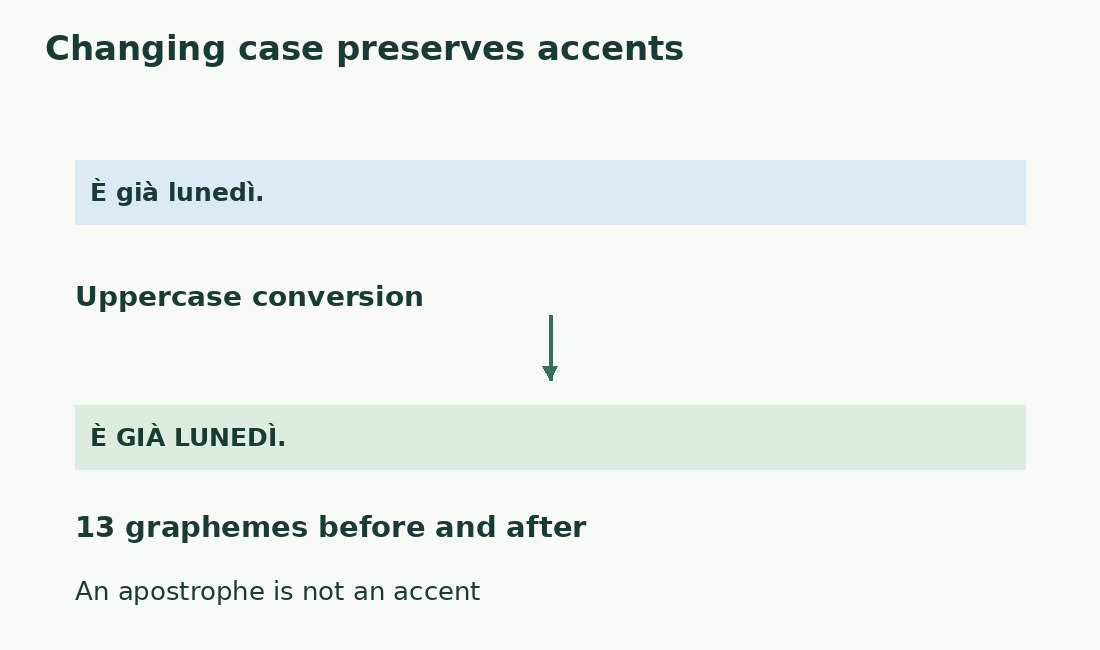
The Italian example retains thirteen characters
Current-function checks give thirteen graphemes and three words for both exact sample strings. The table distinguishes them independently of font appearance.
This does not guarantee invariant length. Foreign names, symbols and other Unicode sequences can differ; bytes are another unit. Convert before final field validation and measure the transformed string in the required unit.
Locale is part of the rule
toLocaleUpperCase() uses language-specific mappings, as MDN documents. Our localized functions use the selected interface language rather than automatically detecting each word’s language. The original Italian examples retain their literal text.
Review foreign names, titles and quotations. Preserve source spelling rather than standardizing names blindly. Multilingual data may need field-specific rules or separate original display and comparison keys. Technical locale and editorial correctness are related but different decisions.
One letter can expand
The site converts Straße to STRASSE, six graphemes becoming seven. MDN warns mappings need not be one-to-one; this example does not establish all-language behavior.
Expansion affects limits and annotation indices. Old positions may shift. Do not remove the last letter to restore length: verify required spelling and field rules, recount and retain the original when useful.
Every-word capitalization is mechanical
Capitalizing each initial can suit graphics or prescribed data but does not edit an Italian title. Articles, prepositions, names and acronyms need contextual treatment.
Use a natural initial capital and review names and acronyms for Italian editorial titles. The tool cannot recognize every brand or surname; lowercasing can damage acronyms. Work on a copy and reread whole titles rather than equating consistency with correctness.
Visual uppercase is not stored conversion
Interfaces can display lowercase content as uppercase through presentation. Our converter returns an actually transformed string. Copying, export and matching can therefore differ despite similar looks.
Paste a sample into plain text to inspect real characters. Agree whether design delivery concerns source or rendering. Sequence inspection also distinguishes faint accents from missing letters.
Comparison differs from conversion
Our duplicate-line tool can compare keys without case while keeping the first original spelling, avoiding unnecessary rewriting.
Ignoring case does not remove accents, unify every apostrophe, resolve similar names or establish identity. Round trips need not recover every original Unicode sequence. Preserve originals for fidelity; declare keys and test pairs that must stay distinct.
Review final output
Inspect accents, acronyms, names and foreign quotations, then character limits. Sample ordinary and special list entries or separate article headings, body and captions. One first paragraph can miss categories.
Repair apostrophes used as accents separately and recount. Resolve TXT decoding first for corrupted input: uppercasing does not reconstruct lost letters. Final copies need correct case and characters.
Conversion can preserve or alter length
| Input | Site uppercase | Graphemes before | After |
|---|---|---|---|
| È già lunedì. | È GIÀ LUNEDÌ. | 13 | 13 |
| Straße | STRASSE | 6 | 7 |
Sources and checks
- MDN: String.toLocaleUpperCase() · Locale-specific mappings and possible character expansion