Two requirement levels
Check the right category: individual story, personal collection and collective anthology can differ. Premio Zeno illustrates distinct conditions for stories and collections; do not transfer its figures to another competition or edition. Keep volume-level and story-level requirements in separate columns. Do not infer an individual threshold or mandatory average from an overall limit.
Inventory stories
List them in delivery order with stable title, version and count; add an internal code if provisional titles change. Check that all appear in the unified copy. Do not add that volume to its separate story files: these verify components, not extra material. For multiple contributors, identify each approved version. Exact counts of an old draft do not describe delivery.
Add homogeneous totals
24,000 + 31,500 + 18,000 characters = 73,500 narrative characters. If included titles, introduction and notes add 2,500, the relevant total is 76,000. Subtract those service components to recover narrative length; discrepancies may reveal duplication, repeated titles or missing entries. Do not invent separator allowances. This site excludes line breaks from battute; compare story sums with a volume count under the same method and scope.
Check each story
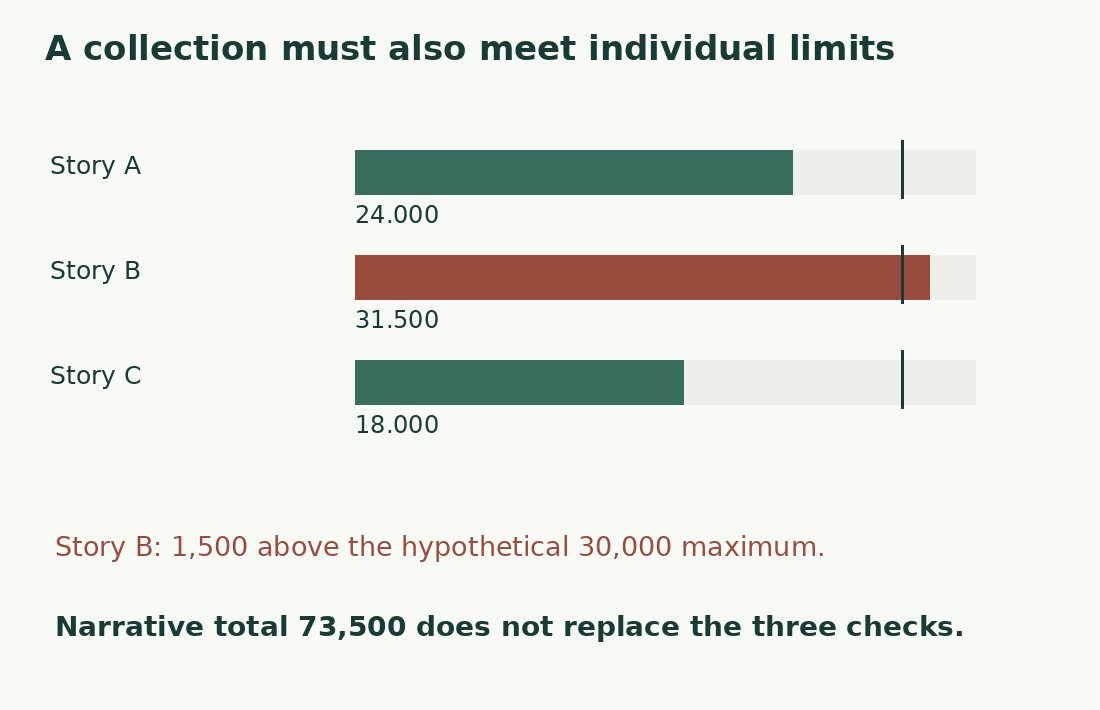
Under a hypothetical maximum of 30,000 per story, an average of 24,500 does not prove compliance: the 31,500 story exceeds by 1,500. A long story likewise cannot compensate for another below an individual minimum. Average describes balance, not each boundary. Apply the same required method to each story and save results; mixed conventions hinder comparison.
For details, see character counter.
Number of works
A long two-story collection does not meet an “at least three stories” requirement. Correct story count does not prove overall minimum length. Record both quantities separately. A novella split into three sections does not automatically become three stories under the rules; classification belongs to the organizer. Make title hierarchy and contents clear enough to match each component with the count table.
Order and surrounding text
Reordering does not itself change story characters but may change section titles, introductions and connective text. Document any added preface’s inclusion and apply consistent rules to part titles. Title/author text in contents is separate material, not duplicated narrative body. Regenerate references and verify every story appears once. An unexpected sum can signal assembly errors but cannot replace inventory checks.
Version changes
For a replacement second story, update its row, preserve the previous total and recount the assembled volume to confirm the correct update. A small net difference can conceal near-total rewriting, so describe replacement alongside quantity. Align the final sheet with the collection version. For separate-file delivery, inspect the actual attachments rather than only your archived unified copy.
Final sheet
Record volume title, ordered stories, individual characters, apparatus, required total, inclusion criteria and checked individual/volume constraints. Convert a homogeneous sum to cartelle after addition; do not round each story first unless specifically required for another purpose. Keep actual length. A text delivery count sheet prevents losing a story, counting it twice or reporting a total for different versions.
Volume and individual checks
| Example component | Characters | If each story has a 30,000 maximum |
|---|---|---|
| Story A | 24,000 | Within limit |
| Story B | 31,500 | 1,500 above limit |
| Story C | 18,000 | Within limit |
| Narrative total | 73,500 | Does not replace the three checks |
| Hypothetical included apparatus | 2,500 | Complete total 76,000 |
Sources and checks
- Associazione Culturale Zeno, bando del concorso · Distinct conditions for individual stories and collections.