Inspect the sequence, not only the picture
A rendered face and composed figure can each look like one symbol while containing different elements. Unicode documents emoji structures; segmentation groups perceived units.
Copy the exact final sequence rather than a description such as “family emoji” or a similar keyboard variant. Keep it with its result so later checks do not depend on remembered artwork or informal names.
Four measured examples
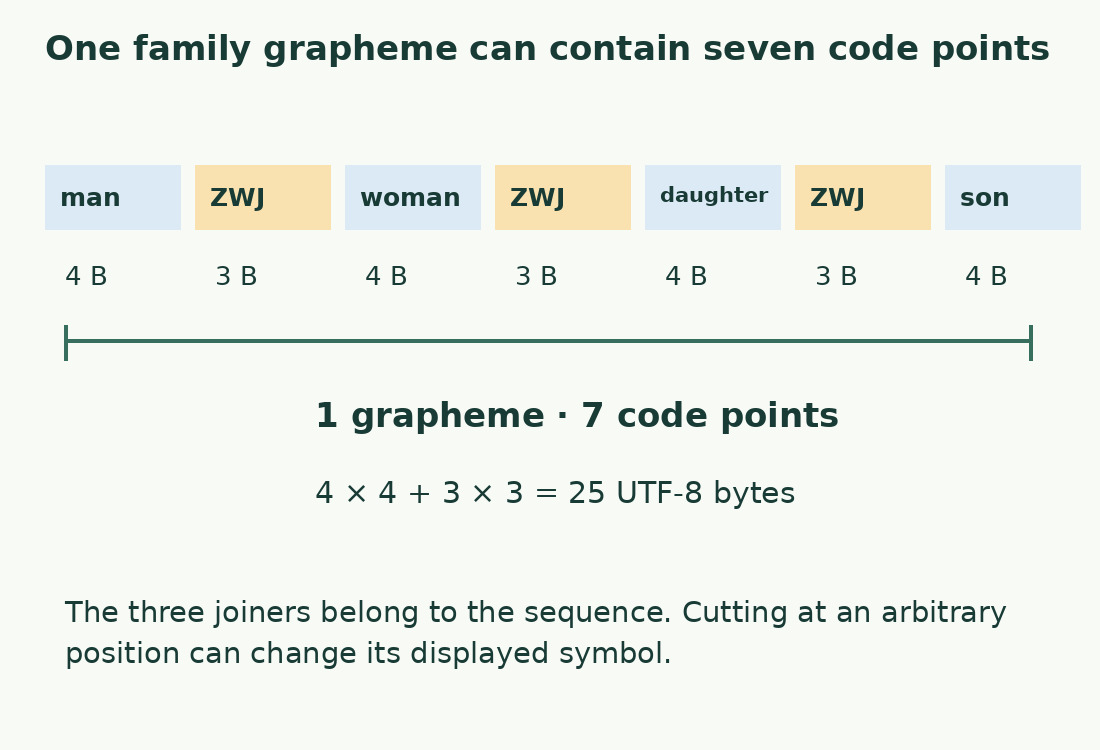
Locally, 🙂 is one grapheme and one code point. 👍🏽 and 🇮🇹 each have one grapheme and two code points. 👨👩👧👦 has one grapheme and seven code points.
These use Intl.Segmenter and code-point iteration, not social limits or every-device tests. Browser fallbacks can differ. Check readability in actual delivery formats as well as internal representation.
Invisible removal can break emoji
Zero-width joiners can combine figures. Deleting every invisible element can split a composed symbol; nonprinting does not mean unnecessary.
Check cleanup previews and sequence preservation. Shorter does not mean equivalent. Visually inspect approved messages and publications. See invisible characters; multilingual writing can also depend on joining elements.
Interpret site statistics separately
Our counter primarily uses graphemes with declared space and newline rules. Lone emoji produced zero words in checks, reflecting text rules rather than meaning.
Adding an emoji can increase Characters without Letters. Word boundaries are another measure. Compare the same content and statistic, rather than one tool’s Characters with another’s JavaScript length.
Verify destination rules
Forms may count graphemes, code points, UTF-16 units or weighted elements; links can have special rules. Generic limits lists do not establish actual behavior.
Read current documentation and test final text at the destination. Our value does not guarantee equivalence. If rejected with apparent room left, identify the required unit before deleting accents or symbols by trial and error.
Do not cut through sequences
Remove complete meaningful elements when shortening. Arbitrary technical indices can leave partial emoji or change appearance. Select the whole symbol and reread.
Consider phrase rewriting or removing unnecessary symbols first. Do not change tone, composition or gender just for shorter representation if it changes the message. Counts show effects but cannot choose editorial sacrifices.
Use bytes for storage constraints
The family uses twenty-five UTF-8 bytes, while modified thumb and Italian flag each use eight. Byte-limited fields therefore differ from visual counts.
Do not multiply every emoji by four. Measure complete sequences in the required encoding; see characters and bytes. An image of an emoji is a different object from text, with potentially different inclusions.
Prepare a verification note
Record exact sequence, both tools’ methods, normalization, newlines and surrounding spaces to analyze discrepancies before assuming errors.
A short invented example avoids sharing confidential documents. Remeasure after sequence edits: a similar picture’s result does not verify final content.
Boxes and separate symbols
Unexpected rendering may reflect device support rather than altered stored elements. Compare copied sequences with the original. A textual description may communicate essential meaning more clearly.
Replacing text with an image does not preserve counts. Body words may exclude images while alternative text belongs elsewhere. Define inclusions for presentations, captions and export formats handling elements differently.
One picture, multiple possible elements
| Sequence | Graphemes | Code points | UTF-8 bytes |
|---|---|---|---|
| 🙂 | 1 | 1 | 4 |
| 👍🏽 | 1 | 2 | 8 |
| 🇮🇹 | 1 | 2 | 8 |
| 👨👩👧👦 | 1 | 7 | 25 |
Sources and checks
- Unicode UTS #51: Unicode Emoji · Emoji sequences, modifiers and zero-width joiners
- MDN: Intl.Segmenter · Locale-aware segmentation including graphemes
- Unicode UAX #29: Text Segmentation · Grapheme-cluster and other text boundaries