Define section boundaries
For an abstract, response, section or chapter, decide what belongs before selecting. Including the heading in only one chapter distorts comparison; a caption crossing sections can be counted twice. A repeatable rule includes each chapter heading and stops before the next, unless the recipient specifies otherwise.
Record the rule before measuring rather than changing it to meet a limit. Check abstract title and keywords separately: the final form may treat them as different fields.
Use selection to measure
Microsoft documents counting selected text. Highlight the passage and inspect its first and last elements before recording the partial total: a long selection can accidentally include the next heading.
With tables or separate objects, verify the selection contains the intended material. A temporary copy of only required content can help. Clear highlighting before reading the document-wide total and label selection figures “partial”.
Make a ledger explaining differences
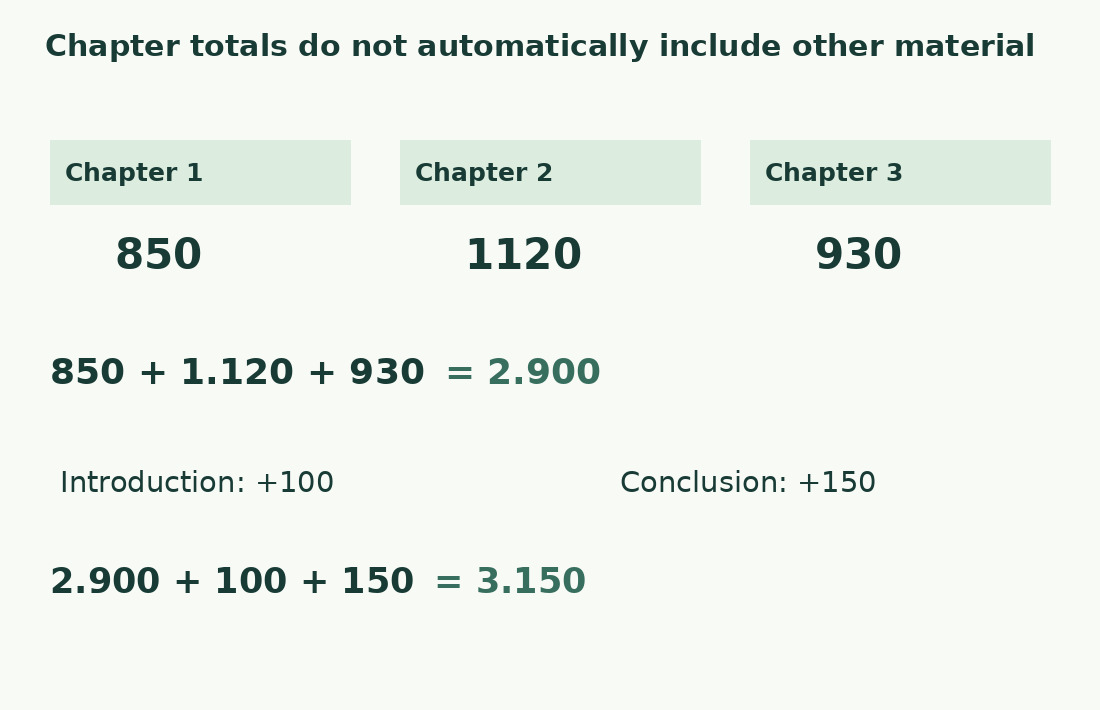
Three sections of 850, 1,120 and 930 words total 2,900. A 100-word introduction and 150-word conclusion bring the whole to 3,150. The 250-word difference can be content outside the chapters rather than an error.
Give each part a row, inclusion column and optionally a margin column. At a 1,100-word limit, chapter two exceeds by 20. These are arithmetic examples, not Word measurements: replace them with final-file counts and preserve the boundary rule.
Check coverage, overlap and units
Every required part must appear once, no heading or paragraph may belong to two rows, and all figures must use the same unit. Do not add words from one chapter to characters from another.
If the sum differs, find unassigned prefaces, appendices or abbreviation lists, repeated headings or a stray next-chapter paragraph. Do not correct the total manually. Apply one note rule throughout; see notes and text boxes.
Recount after moving text
Moving a paragraph between chapters can leave the whole unchanged while changing both partials. Mark and recount affected chapters, then check the final total. When splitting a section, establish new boundaries instead of allocating old words in proportion to pages, which differ in density.
The ledger locates revision needs without requiring equal chapter lengths. A long section may need cuts or relocated material; the count cannot make that editorial decision.
Check separate destination fields
After pasting sections, inspect the actual content. Added titles, individual field limits and transformations of spaces may alter the relevant result. Word is a preparatory check; the destination may use its own rules.
Use the online word counter for one passage and a working limit. Copy only the required section, excluding accidental “Abstract” labels or revision notes. Follow official submission-counter instructions. Keep the ledger with the measured copy so colleagues can reproduce the scope.
Handle appendices and repeated headings
A chapter may contain a local introduction, case study and appendix. Group them under its identifier if the limit covers the whole chapter; explicitly mark an excluded appendix instead of subtracting from memory.
Distinguish the body title from repeated page-header text. Define whether editorial content counts once or each file element individually; do not multiply titles by page count from print view. Retain old and new figures: 930 to 975 is +45, useful for distributing cuts without forcing equal lengths.
Why chapters may not explain the total
| Part | Example words | In overall total |
|---|---|---|
| Chapters 1, 2 and 3 | 850 + 1,120 + 930 = 2,900 | Yes |
| Introduction | 100 | Yes |
| Conclusion | 150 | Yes |
| Overall total | 3,150 | No part repeated |
Sources and checks
- Microsoft: Word count and selections · Document and partial-selection statistics.